
Queqiao relay satellite
췌차오 중계 위성
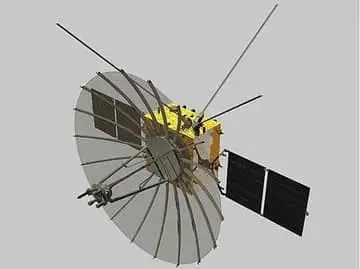
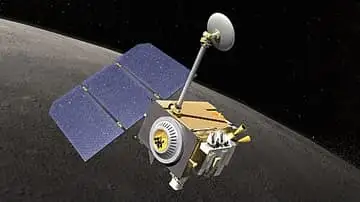
From the far side Earth can’t be seen, so radio can’t reach. Queqiao loops far behind the Moon, passing messages between Chang’e 4 and Earth. Its name means “magpie bridge”, the bridge that joins two lovers in a Chinese legend.
See it on the 3D Moon →At a glance
- Where
- Far beyond the far side (L2)
- 📅 Launched
- 2018-05-21
- 🚀 Sent by
- CNSA (China)
- 📡 Antenna
- 4.2 m dish antenna
- Kind
- Spacecraft in orbit
Queqiao is a Chinese relay satellite that works like a telephone exchange in space. The far side of the Moon always faces away from Earth, so a lander there cannot send radio signals straight home. Queqiao solves this by hovering far beyond the Moon, where it can see both the far side and Earth at the same time, and passing messages between them.
China launched Queqiao on a Long March 4C rocket from the Xichang Satellite Launch Center on 21 May 2018, Beijing time. About seven months later its partner, the Chang'e 4 lander and the Yutu-2 rover, touched down on the far side, the first soft landing ever made on the far side. Queqiao means 'magpie bridge', after a Chinese folk tale in which magpies form a bridge so two separated lovers can meet.
How it works
Queqiao circles a balance point in space called Earth–Moon L2, about 65,000 km behind the Moon. It does not sit still there; it travels on a large loop called a halo orbit. Because the loop is so wide, Queqiao never hides behind the Moon, so it always has a view of Earth. It took 24 days to reach its working orbit, which it entered on 14 June 2018, while a normal trip into lunar orbit takes only four or five days.
The big dish
To catch the faint signals from the far side and pass them on, Queqiao unfolds a dish antenna 4.2 m across. When it launched, this was described as the largest antenna on any deep-space exploration satellite. Queqiao weighed about 449 kg at launch. It was planned to work for five years but kept going well beyond that, and a second relay satellite, Queqiao-2, joined it in March 2024.
Fun facts
- Queqiao was the first relay satellite ever placed at the Earth–Moon L2 point behind the Moon.
- Its name, 'magpie bridge', comes from the folk tale of the Cowherd and the Weaver Girl.
- Queqiao's unfolding dish antenna is 4.2 m wide, which made it the largest on any deep-space exploration satellite when it launched.
- Two tiny satellites, Longjiang-1 and Longjiang-2, launched on the same rocket to study the sky with low-frequency radio waves.
On the 3D Moon
On the 3D Moon you can see Queqiao looping far out behind the far side, the relay that carries messages between Chang'e 4 and Earth.
More on the Moon



Sources
- Read more on Wikipedia
- Queqiao-1 — Wikipedia
- Queqiao orbit explainer — The Planetary Society
- How do spacecraft communicate from the farside of the Moon? — Astronomy
Updated: 2026-10-19