
Galápagos Rift hydrothermal vents
갈라파고스 열수구
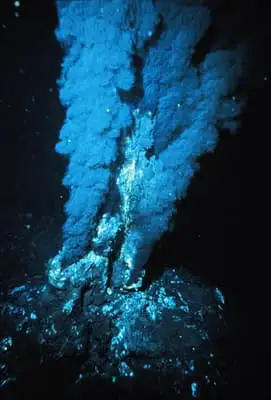
The first hydrothermal vents ever seen, found by the submersible Alvin in 1977 about 2,500 m down. Giant tube worms and clams living on chemical energy, without sunlight, changed ideas about where life can exist.
See it on the 3D globe →At a glance
- Kind
- Deep sea
In 1977 the research submarine Alvin dived to the Galápagos Rift in the Pacific Ocean and found something nobody had seen before: hydrothermal vents. These are cracks in the seafloor where water heated by the Earth gushes out.
Around them lived crowds of giant tube worms, clams and other animals, even though no sunlight reaches that deep. They get their energy from chemicals in the vent water, not from the Sun, which changed what scientists thought about where life can exist. Scientists now know of vents in oceans all over the world, and some think life on Earth may even have started near such vents.
What is a hydrothermal vent?
A hydrothermal vent is a crack in the seabed that releases water heated by hot rock underground. Vents are common where tectonic plates pull apart, along ridges in the middle of the oceans. Some build chimneys called black smokers or white smokers. They add many minerals and chemicals to the sea, and they support rich communities of living things in an otherwise sparse deep ocean.
How do animals live without sunlight?
Tiny bacteria and archaea use chemicals from the vents, such as hydrogen sulfide, to make food. This is called chemosynthesis, and these microbes are the base of the food chain. The giant tube worm Riftia, first seen in 1977 on the Galápagos Rift, can grow up to three metres long. It has no mouth or stomach and relies on bacteria living inside it. It is also the fastest-growing marine invertebrate known.
Fun facts
- Found in 1977, these were the first hydrothermal vents ever seen, surrounded by giant tube worms that live without sunlight.
- Giant tube worms were first found at the Galápagos Rift in 1977.
- A tube worm can grow to 1.5 metres in less than two years.
- Scientists think vents may exist on Jupiter's moon Europa and Saturn's moon Enceladus.
On the globe
The model shows a vent on the deep seafloor surrounded by giant tube worms.
Nearby on the globe







Sources
Updated: 2026-10-14