
Lunar Gateway
루나 게이트웨이
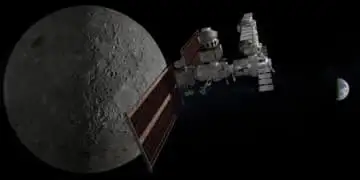
A small space station that several countries planned to build in lunar orbit, on a long stretched orbit — low over the north pole, far out over the south — as a stopover for astronauts. In March 2026 NASA paused it in this form to focus on a base on the surface.
See it on the 3D Moon →At a glance
- Where
- A planned lunar station, paused in 2026
- 🚀 Sent by
- NASA · ESA · JAXA · CSA · UAE
- 🔄 Orbit
- Near-rectilinear halo orbit (one lap in about 7 days)
- Kind
- Spacecraft in orbit
The Lunar Gateway was a small space station that NASA and its partners planned to build in orbit around the Moon. The partners were the European Space Agency (ESA), Japan's JAXA, the Canadian Space Agency and the Mohammed bin Rashid Space Centre of the United Arab Emirates. Gateway was meant to be a stopover where astronauts could live, work and switch spacecraft on their way down to the lunar surface.
Work on Gateway began in 2017 as part of NASA's Artemis program. In March 2026, though, NASA announced that it would pause Gateway in its current form and put its effort into a base on the Moon's surface instead. Some of the hardware already built is being reused, and NASA said the idea of an orbiting outpost could be revisited in the future.
How it would work
Gateway was designed to fly on a long, stretched path called a near-rectilinear halo orbit. On each lap, which takes about seven days, it would swing low over the Moon's north pole and then loop far out, about 70,000 km, over the south pole. This path has only short breaks in radio contact with Earth and needs very little fuel to hold. Up to four astronauts could stay on board, and it was planned to last 15 years.
The pieces
Gateway was a team project made of modules from different countries. The Power and Propulsion Element would provide electricity and gentle solar-electric thrust, and the HALO module would be the first living space. ESA and JAXA worked on a second home module called I-Hab and a communications and refuelling module called ESPRIT. Canada was building Canadarm3, a smart robotic arm, and the UAE was building an airlock for crew and science.
What happened next
When NASA paused the project in 2026, its partners in Canada, Europe and Japan were unhappy, and the hardware they had been building was reviewed for possible use on the Moon's surface. The Power and Propulsion Element is being repurposed as the core of a nuclear-electric propulsion spacecraft. NASA said suitable equipment would be reused and its partners' commitments would be put toward the new Moon base plans.
Fun facts
- On its planned orbit, Gateway would take about a week to go once around the Moon.
- Gateway's planned orbit would carry it about 70,000 km out from the Moon at its farthest point, over the south pole.
- Five space agencies from the USA, Europe, Japan, Canada and the UAE worked together on Gateway.
- Canada's part of Gateway was Canadarm3, a robot with a large arm and a smaller, nimbler arm for fixing and building things.
On the 3D Moon
On the 3D Moon you can see Gateway on its long stretched orbit, low over the north pole and far out over the south, the stopover station that was planned for astronauts heading down to the surface.
More on the Moon




Sources
- Read more on Wikipedia
- Lunar Gateway — Wikipedia
- NASA Unveils Initiatives to Achieve America's National Space Policy — NASA
- NASA halts work on Gateway to develop a lunar base — SpaceNews
- NASA's lunar Gateway space station is out. Moon bases are in. — Space.com
Updated: 2026-10-19