
Mid-Atlantic Ridge black smokers (TAG)
대서양 중앙 해령 블랙 스모커 (TAG)
The TAG hydrothermal field, about 3,600 m deep on the Mid-Atlantic Ridge: on top of a large sulphide mound, chimneys called black smokers vent water above 350 °C, clouded black with metal sulphides, and swarms of white vent shrimp live on them.
See it on the 3D globe →At a glance
- Kind
- Deep sea
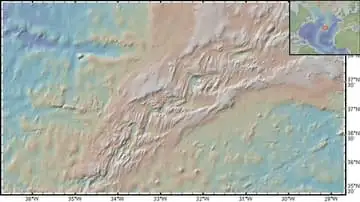
The TAG hydrothermal field sits on the Mid-Atlantic Ridge, the underwater mountain chain running down the middle of the Atlantic Ocean, at about 26 degrees north. It lies roughly 3,600 metres deep, where the seafloor is pulled apart and new crust forms. Its main feature is a mound of mineral deposits about 250 metres wide and 40 metres tall.
Chimneys on top, called black smokers, spout fluid as hot as about 365 degrees Celsius, clouded dark by tiny particles of metal sulfides. It was one of the first places where scientists could watch black smokers directly from a submarine in the Atlantic. Hydrothermal vents are cracks in the seabed where water heated by the Earth comes out. The globe marks the field as a mystery site on the deep Atlantic floor.
Why are black smokers black?
Seawater seeps into cracks in the ocean floor, is heated by hot rock below, and picks up metals and sulfur. When this very hot fluid shoots into the near-freezing sea, minerals suddenly form as tiny dark particles, making the plume look like smoke.
Around the centre of the TAG mound the vents are hottest, and toward the edges they cool into white smokers and gentle seeping flows.
How a chimney grows
Vent water can be 60 up to 464 degrees Celsius, while the surrounding deep water is about 2 degrees. Even so, the water does not boil, because the pressure at that depth is so high.
A chimney begins when the mineral anhydrite is deposited. Sulfides of copper, iron and zinc then fill the gaps, so the chimney gets less porous. Growth of about 30 centimetres in a day has been recorded, and some chimneys reach 60 metres.
What have scientists done here?
TAG stands for Trans-Atlantic Geotraverse, a research project. In 1994, the drilling ship of Ocean Drilling Program Leg 158 drilled into the TAG mound. It was the first time anyone had drilled into an active seafloor hot-spring system on a mid-ocean ridge with no sediment cover.
Later dives also found large inactive mounds nearby, left from older vent activity. Modern study of deep-sea vents began in the 1970s, and in 1977 scientists near the Galápagos Islands saw vents and their rich animal communities for the first time.
Fun facts
- Black smokers spout mineral-rich water hotter than 350 °C, which turns black as metal particles form in the cold sea.
- The active mound is about as wide as two and a half football pitches.
- Drilling here in 1994 was the first into an active, sediment-free ridge vent system.
- Vents like these feed animals such as shrimp, living in total darkness.
- Some vent chimneys have been recorded growing about 30 centimetres in a single day.
On the globe
The model shows a mound with black smoker chimneys on the deep seafloor and shrimp swarming near them.
Nearby on the globe



Sources
- Read more on Wikipedia
- Hydrothermal vent — Wikipedia
- TAG hydrothermal field research paper — Woods Hole Oceanographic Institution
- 열수분출공 — 위키백과
Updated: 2026-10-14