
Boudhanath Stupa
보우다나트 스투파
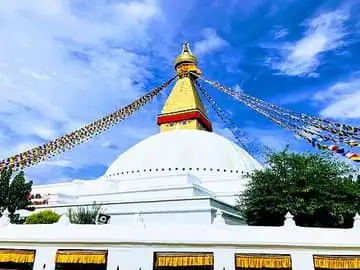
Boudhanath, also called the Boudha Stupa, is a giant white dome-shaped Buddhist monument in the town of Boudha, in Kathmandu, Nepal. It is about 36 metres tall and is one of the largest round stupas in the world. A gold tower with the painted eyes of the Buddha looking in four directions sits on top, and strings of prayer flags hang from it. It stands in the north-east of the Kathmandu Valley and was once surrounded by rice fields.
See it on the 3D globe →At a glance
- Country
- Nepal
- Location
- Kathmandu, Nepal
- Built
- c. 5th c.
- Height
- 36 m
- Type
- Religious building
Quick answers
Where is Boudhanath Stupa?
Boudhanath Stupa is in Kathmandu, Nepal.
How tall is Boudhanath Stupa?
Boudhanath Stupa is about 36 m tall.
One of the largest stupas in the world, with the Buddha’s eyes gazing in four directions, a 13-step golden spire and prayer flags.
Its layout is a huge mandala, a sacred pattern used in Tibetan Buddhism. It is a major place of pilgrimage and part of a UNESCO World Heritage Site. Along with Swayambhunath and Namo Buddha, it is one of the most visited Buddhist pilgrimage sites in Nepal.
History
Old Newar chronicles mention a stupa here as early as the 5th century, but the present building was most likely built in the 14th century. It stands on the old trade route between Tibet and India, so Tibetan merchants stopped here to pray for many centuries. After the 1959 Tibetan uprising many refugees settled around it, and more than 50 monasteries were built nearby. UNESCO listed it in 1979.
Visiting today
Pilgrims walk around the stupa clockwise, spinning prayer wheels, and it is one of the most visited Buddhist sites in Nepal. The stupa is said to hold sacred relics, including bone pieces believed to be from Buddhas. Near the northern entrance is a shrine to the protectress Ajima, cared for by a nearby monastery.
The legend of the poultry farmer
A story told in Tibetan Buddhism explains how the stupa began. A woman named Samvari, who kept poultry in the Kathmandu Valley, wished to build a great monument. She asked the local king for land, and he answered "Jarung!", meaning "Let it be done!". She built it with bricks carried by an elephant and a donkey, and after she died her four sons finished the work. When local people complained that it was too large, the king said the words had slipped from his tongue, which gave the stupa its Tibetan name, Jarung Kashor.
Fun facts
- The eyes of the Buddha painted on it look out in all four directions.
- The stupa lies on an old trade route from Tibet to India.
- More than 50 monasteries grew up around it after 1959.
- It was once surrounded by rice fields.
- Its Tibetan name Jarung Kashor means roughly "let it be done" and "slipped from the tongue".
On the globe
The model shows the white dome, the golden spire with the Buddha's eyes and the prayer flags. Look for the 13 steps of the tower.
Quiz time
Which is taller: Boudhanath Stupa or Potala Palace?
Show the answer
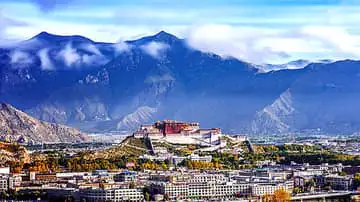
Potala Palace. (36 m vs 119 m) Potala Palace →
Nearby on the globe

Sources
Updated: 2026-10-14