
Mount Everest
에베레스트산
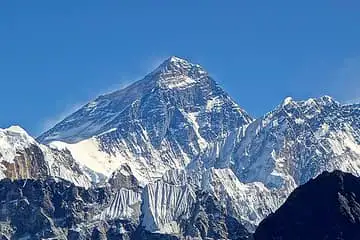
Mount Everest is the highest mountain above sea level on Earth. Its summit stands 8,848.86 metres high, a figure announced jointly by Nepal and China in December 2020 after both countries sent survey teams to the top. The mountain lies in the Himalayas, right on the border between Nepal and the Tibet region of China.
See it on the 3D globe →At a glance
- Country
- Nepal
- Location
- Nepal–China border
- Height
- 8,849 m
- Type
- Mountain
Quick answers
Where is Mount Everest?
Mount Everest is in Nepal–China border.
Earth's highest mountain above sea level at 8,849 m, in the Himalayas.
Everest has several names. In Nepal it is called Sagarmatha, and in Tibetan it is Chomolungma, often translated as "holy mother". The English name honours Sir George Everest, a British surveyor in India, and was adopted in 1865. Edmund Hillary and Tenzing Norgay were the first people known to reach the summit, on 29 May 1953. The national park around its Nepali side has been a UNESCO World Heritage Site since 1979.
How tall is Everest, really?
Measuring a mountain this high is tricky. A British survey around 1856 gave about 8,842 metres. The Survey of India's 1954 figure of 8,848 metres was used for decades. In 1999 a National Geographic team using GPS measured 8,850 metres, and a Chinese team in 2005 measured the rock alone, without the snow cap, at 8,844.43 metres. For the 2020 number, Nepali climbers carried GPS equipment to the summit in 2019 and a Chinese team followed in spring 2020, measuring the snow too.
A mountain made from an old sea floor
Everest is still being pushed upward, because the Indian tectonic plate keeps pressing into Asia; estimates of the rise are a few millimetres a year. Amazingly, the rock at the very top is limestone that formed on the bottom of a shallow sea more than 400 million years ago, in the Ordovician period. Scientists have found tiny fossil pieces of sea creatures such as trilobites and crinoids in summit rocks. In 2022 geologists named these the highest rocks on the planet.
Climbing in the sky
The thin air is one of the biggest dangers, and getting enough oxygen is a major challenge for climbers. Winds often reach about 160 km/h, and average temperatures at the top stay far below freezing all year, from around minus 36 °C in winter to minus 18 °C in summer. Even so, by the end of 2024 Everest had been climbed almost 13,000 times by around 7,200 different people. Dangers such as avalanches, the shifting ice of the Khumbu Icefall and altitude sickness make it a serious challenge.
Fun facts
- Edmund Hillary and Tenzing Norgay first reached the summit in 1953.
- The rocks at the top of Everest formed on the floor of an ancient sea.
- Fossil pieces of trilobites, sea animals that lived long before the dinosaurs, have been found in summit rocks.
- Sir George Everest, the man the mountain is named after, actually objected to the honour.
- Winds near the summit have been measured at 280 km/h.
- By the end of 2024, people had reached the top almost 13,000 times.
On the globe
The model shows Earth's highest mountain, rising to 8,849 m in the Himalayas. Look for the tallest peak among its neighbours and the clouds streaming from its summit.
Nearby on the globe



Sources
- Read more on Wikipedia
- Mount Everest — Wikipedia
- China, Nepal say Everest a bit higher than past measurements — Associated Press (via Audacy)
Updated: 2026-10-13