
Potala Palace
포탈라궁
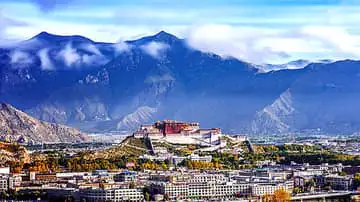
The Potala Palace is a huge palace-fortress in Lhasa, the capital of the Tibet Autonomous Region of China. It stands on Marpo Ri hill, about 3,700 metres above sea level, in the middle of the Lhasa valley. From 1649 until 1959 it was the winter palace and residence of the Dalai Lamas, and today it is a museum and a symbol of Tibetan Buddhism. It is named after Mount Potalaka, regarded in Buddhist tradition as the home of the bodhisattva Avalokiteshvara.
See it on the 3D globe →At a glance
- Country
- China
- Location
- Lhasa, Tibet, China
- Built
- 1649
- Height
- 119 m
- Type
- Palace
Quick answers
Where is Potala Palace?
Potala Palace is in Lhasa, Tibet, China.
When was Potala Palace built?
Potala Palace was built in 1649.
How tall is Potala Palace?
Potala Palace is about 119 m tall.
The former winter palace of the Dalai Lamas, rising in white and red tiers up a hillside in Lhasa.
The present palace was begun in 1645 on the order of the Fifth Dalai Lama, on the site of an older palace linked to King Songtsen Gampo. It measures about 400 metres east to west and 350 metres north to south, rises 13 stories, and has more than 1,000 rooms, about 10,000 shrines and some 200,000 statues. It was added to the UNESCO World Heritage List in 1994.
White, red and a long build
The Dalai Lama and his government moved into the White Palace in 1649. The Red Palace in the centre was added between 1690 and 1694 and holds the main halls, chapels and shrines. The outer structure took three years, but the inside with its furnishings took 45 years. Two chapels in the northwest corner preserve parts of the earlier palace, including a cave identified as Songtsen Gampo's meditation cave.
Built to last
The palace is built in the dzong style. Its sloping stone walls average 3 metres thick and are 5 metres thick at the base, and copper was poured into the foundations to protect against earthquakes. The English Wikipedia gives its height as 119 metres above the mountain and over 300 metres above the valley floor. The red, white and yellow colours of the walls come from the way they are painted and decorated.
Today
The Dalai Lama left Tibet in 1959, when the palace was damaged during an uprising. It escaped harm in 1966 thanks to the personal intervention of Zhou Enlai, then premier. Large restoration works took place from 1989 to 1994 and from 2002. Because of crowding, visits were limited to 1,600 a day from 2003, and the number was later raised to 2,300. In the area around the palace, buildings taller than 21 metres are banned to protect its atmosphere.
Fun facts
- It has more than 1,000 rooms.
- The palace stands about 3,700 metres above sea level.
- Building the outside took three years, but finishing the inside took 45.
- Copper was poured into its foundations to guard against earthquakes.
- It has about 200,000 statues.
On the globe
The model shows the white and red palace climbing the hillside. Look for the red central block.
Quiz time
Which is taller: Potala Palace or Boudhanath Stupa?
Show the answer
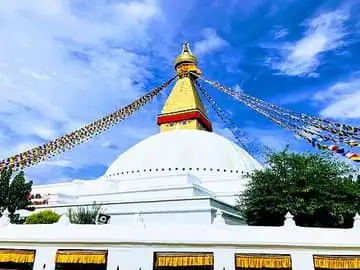
Potala Palace. (119 m vs 36 m) Boudhanath Stupa →
Nearby on the globe

Sources
Updated: 2026-10-14