
Paro Taktsang (Tiger's Nest)
탁상 사원 (호랑이 둥지)
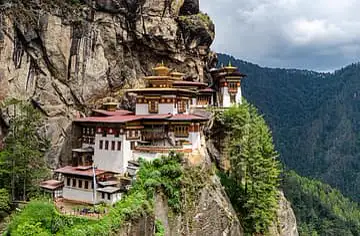
Paro Taktsang, better known as the Tiger's Nest, is a Buddhist monastery built on the edge of a steep cliff in the upper Paro valley of Bhutan, a small mountain kingdom in the Himalayas. It sits about 3,120 metres above sea level and roughly 900 metres above the valley floor, so from below its white buildings seem to hang in the air.
See it on the 3D globe →At a glance
- Country
- Bhutan
- Location
- Paro, Bhutan
- Built
- 1692
- Type
- Religious building
Quick answers
Where is Paro Taktsang (Tiger's Nest)?
Paro Taktsang (Tiger's Nest) is in Paro, Bhutan.
When was Paro Taktsang (Tiger's Nest) built?
Paro Taktsang (Tiger's Nest) was built in 1692.
A Buddhist monastery clinging to a cliff about 900 m above the Paro valley.
The monastery is one of the holiest places in Bhutan. It surrounds a cave where Guru Rinpoche, also called Padmasambhava, is believed to have meditated. He is the teacher honoured for bringing Buddhism to Bhutan more than a thousand years ago. The monastery buildings were put up in 1692 by Gyalse Tenzin Rabgye, one of the country's early rulers. Today it is Bhutan's best-known landmark, and pilgrims and travellers make the long walk up the mountain to reach it.
The legend of the tigress
The name Tiger's Nest comes from a legend. Guru Rinpoche is said to have flown to this cliff on the back of a tigress, then stayed in the cave to meditate and tame a demon that troubled the area. One version of the story says the tigress was really a former queen who changed her shape to carry him. Traditional accounts say he meditated here for three years, three months, three weeks, three days and three hours.
How it was built and rebuilt
The complex has four main temples and living quarters for monks, built right into the rock, plus eight caves around it. In April 1998 a fire broke out in the main building and destroyed many old paintings, statues and treasures, and a monk lost his life. The government and the king oversaw the restoration, and the rebuilt monastery was completed in 2005. Monks who come to practise in the caves traditionally stay for three years.
Visiting today
There is no road to the monastery. Visitors hike a trail of about 6 kilometres in total through pine forest, which takes around four to seven hours there and back. About halfway up is a cafeteria with the first good view of the buildings, and some people rent a small horse or pony to ride up to that point, saving about an hour. Further on, the path passes a waterfall bridge before reaching the temples. In spring the Paro valley holds a big festival, the Tsechu, in honour of Guru Rinpoche.
Fun facts
- Legend says Guru Rinpoche flew here on the back of a tigress.
- The monastery sits about 900 metres above the valley floor, higher than two Eiffel Towers stacked on top of each other.
- Legend says Guru Rinpoche arrived here flying on the back of a tigress.
- After a fire in 1998, the monastery was carefully rebuilt and reopened by 2005.
- There is no road up: everyone walks, or rides a pony for part of the way.
On the globe
The model shows a Buddhist monastery clinging to a cliff high above the Paro valley. Zoom in on western Bhutan, in the Himalayas, to find it on its rock face.
Quiz time
Which is older: Paro Taktsang (Tiger's Nest) or Lotte World Tower?
Show the answer
Paro Taktsang (Tiger's Nest). (1692 vs 2017) Lotte World Tower →
Nearby on the globe
.jpg)
Sources
- Read more on Wikipedia
- Paro Taktsang — Wikipedia
- 파로 탁상 — 한국어 위키백과
- Tiger's Nest Bhutan: what you need to know — Koryo Tours
Updated: 2026-10-13