
Mogao Caves
막고굴
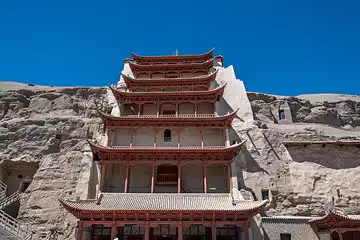
The Mogao Caves are a huge group of Buddhist cave temples cut into a cliff about 25 kilometres southeast of Dunhuang, an oasis on the Silk Road in Gansu, China. There are about 500 caves, with painted walls covering roughly 46,000 square metres, and clay statues inside. They were made over about a thousand years, starting in AD 366.
See it on the 3D globe →At a glance
- Country
- China
- Location
- Dunhuang, China
- Built
- 366–1368
- Type
- Religious building
Quick answers
Where is Mogao Caves?
Mogao Caves is in Dunhuang, China.
492 cave temples cut over a millennium into a cliff at the Silk Road oasis of Dunhuang, filled with murals and painted statues.
Dunhuang was a frontier outpost founded by the Han dynasty in 111 BC and became a crossroads where traders, monks and ideas travelled between China and the west. The caves are among the best known of China's Buddhist grottoes, together with Longmen and Yungang. They became a World Heritage Site in 1987, and visitor numbers are limited to help protect the paintings.
How it began
According to tradition, a monk named Le Zun had a vision of a thousand Buddhas bathed in golden light in 366 and began carving a cave here; one old document gives the date as 353. The oldest decorated caves that survive, caves 268, 272 and 275, date to between 419 and 439. Over the centuries, pilgrims, rulers, merchants and local families paid for more caves and more paintings. Tang-dynasty caves, from AD 618 to 907, are the largest group, and by then there were over a thousand caves.
Pictures that taught
The painted walls were not just decoration. They helped monks meditate and showed the road to enlightenment, and they taught Buddhist stories to people who could not read. In 695, after Empress Wu Zetian ordered giant statues across the country, the largest Buddha of Mogao was built. Making new caves stopped after the Yuan dynasty, as the Silk Road lost importance to sea routes.
The hidden library
On 25 June 1900, a Taoist abbot named Wang Yuanlu discovered a sealed chamber that had been walled up in the early 11th century. It held a huge store of manuscripts. Among them was a copy of the Diamond Sutra dated 868, regarded as the oldest dated printed book. Foreign explorers later took many items abroad; today the largest collections are in Beijing, London, Paris and Berlin.
Fun facts
- A sealed library cave here held a Diamond Sutra printed in 868, the oldest dated printed book.
- The caves' wall paintings cover about 46,000 square metres.
- A sealed library cave was found in 1900.
- The Diamond Sutra found there is dated 868.
- The caves were made over about 1,000 years.
On the globe
The model shows a cliff face cut with rows of cave temples above the Dunhuang oasis.
Nearby on the globe



.jpg)
Sources
Updated: 2026-10-14