
Preikestolen (Pulpit Rock)
프레이케스톨렌
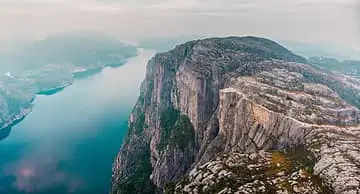
Preikestolen, also called Pulpit Rock, is a steep cliff in Rogaland county in western Norway. It rises 604 metres straight up from the Lysefjord, a long, narrow arm of the sea between tall mountains, and its top is an almost flat square of rock about 25 by 25 metres. It got its name because it looks like a pulpit, the raised stand a preacher speaks from in a church.
See it on the 3D globe →At a glance
- Country
- Norway
- Location
- Rogaland, Norway
- Height
- 604 m
Quick answers
Where is Preikestolen (Pulpit Rock)?
Preikestolen (Pulpit Rock) is in Rogaland, Norway.
How tall is Preikestolen (Pulpit Rock)?
Preikestolen (Pulpit Rock) is about 604 m tall.
A flat-topped cliff jutting 604 m above the Lysefjord, one of Norway's most famous hikes.
Standing on the edge and looking down at the deep blue fjord far below is one of the most famous views in Norway, and travel guides have named it among the world's most spectacular viewpoints. More than 300,000 people hike to the top every year, making it one of Norway's most visited natural attractions. The city of Stavanger is only about 25 kilometres away.
How it formed
Preikestolen was shaped about 10,000 years ago, near the end of the last ice age, when the edge of a huge glacier reached the cliff. Meltwater seeped into cracks in the rock and froze. Because water expands when it turns to ice, it pried off big angular blocks of stone, and the moving glacier carried them away. That is why the plateau has such straight edges and sharp corners. A deep crack still runs across the top. Geologists say the rock will fall one day, but their studies show this will not happen any time soon, and the plateau is safe.
Visiting today
There is no road to the top, so you have to walk. The usual trail starts at a car park about 270 metres above sea level and climbs about 3.8 kilometres each way, up ridges and across rocky ground, which takes about four hours there and back. In 2013 a team of Sherpas from Nepal began rebuilding the steepest parts with stone steps. There is no fence at the edge: Norwegian authorities decided railings would spoil the place, and accidents are extremely rare. You can also see the cliff from below on a boat trip along the Lysefjord.
History of the name
Local people once called the rock Hyvlatånnå, meaning "the plane's blade", after the tool carpenters use to shave wood, and sailors on the fjord used it as a landmark. Around 1900 a ship's captain on the Lysefjord pointed up at it and said it looked just like a pulpit. A local tourist group then gave it the name Prekestolen to attract hikers, and the spelling later became Preikestolen to match the local form of Norwegian. In 1949 a trekking association built a cabin near the start of the trail.
Fun facts
- Its flat top is roughly 25 m by 25 m.
- Tourism here began around 1900, when a gymnast named Thomas Peter Randulff decided to climb the rock after a ship's captain said it looked like a pulpit.
- The square shape was carved by ice that froze in cracks and broke off big blocks of rock.
- The steep parts of the trail were rebuilt by Sherpas from Nepal, famous for their skill in the Himalayas.
- There is no fence at the 604-metre drop, on purpose.
- Air from the Lysefjord and Preikestolen area has even been sold in cans as a souvenir.
On the globe
The model shows the flat-topped cliff jutting out 604 metres above the Lysefjord in Norway. Look for the square, flat top that hikers stand on to look down at the fjord.
Quiz time
Which is taller: Preikestolen (Pulpit Rock) or Oslo Opera House?
Show the answer
Preikestolen (Pulpit Rock). (604 m vs 50 m) Oslo Opera House →
Nearby on the globe



Sources
- Read more on Wikipedia
- Preikestolen — Wikipedia
- Preikestolen — Fjord Norway (official regional tourism)
Updated: 2026-10-13