
Wat Arun
왓 아룬
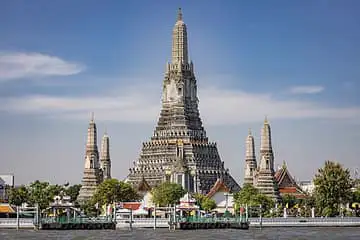
Wat Arun, the "Temple of Dawn", is a Buddhist temple on the west bank of the Chao Phraya River in Bangkok, the capital of Thailand. Its full name is Wat Arun Ratchawararam Ratchawaramahawihan, and it is named after Aruna, a Hindu god who drives the chariot of the sun and stands for the light of sunrise.
See it on the 3D globe →At a glance
- Country
- Thailand
- Location
- Bangkok, Thailand
- Built
- 19th c.
- Height
- 70 m
- Type
- Religious building
Quick answers
Where is Wat Arun?
Wat Arun is in Bangkok, Thailand.
The "Temple of Dawn" on the Chao Phraya River, its spire studded with colourful porcelain.
The temple is best known for its central prang, a tall tower in a style that came from ancient Khmer temples. Sources give its height as somewhere between about 67 and 86 metres, depending on how it is measured. The tower is covered all over with pieces of colourful Chinese porcelain and seashells arranged into flowers and patterns, so it sparkles in the sunlight. It is one of the most famous sights of Bangkok and is especially beautiful seen from across the river at sunset.
History
A temple stood here as early as the Ayutthaya period, when it was called Wat Makok. In 1767 King Taksin arrived at the spot and later made it the royal temple of his new capital, Thonburi, renaming it Wat Chaeng. The famous Emerald Buddha statue was kept here until the 1780s, when it was moved to Wat Phra Kaew across the river. King Rama II started raising the great central prang, and King Rama III finished it in 1851.
How it was decorated
The prang is covered with porcelain from China. Some of these pieces had travelled to Bangkok as ballast, the heavy material that ships carry low in their hulls to keep them steady at sea. Craftspeople pressed the broken plates, bowls and shells into the plaster to make flowers and patterns. The central tower stands for Mount Meru, the mountain at the centre of the universe in Hindu and Buddhist beliefs, and four smaller towers stand around it. A big restoration between 2013 and 2017 cleaned and repaired the decoration.
Visiting today
The temple sits right on the riverbank, where six Chinese-style pavilions line the water. The stairs on the central tower are very steep, and today visitors can climb only up to the first level, which still gives a good view over the river. The four smaller towers around the central one are dedicated to Phra Phai, the god of the wind. Statues of giant guardians, called yaksha, from the Ramakien (the Thai version of the Indian epic Ramayana) protect the entrance to the ordination hall, where monks are ordained.
Fun facts
- Some of the porcelain on the tower first came to Thailand as ballast in the bottom of trading ships from China.
- The temple is named after Aruna, the Hindu god of the dawn who drives the sun's chariot.
- The prang of Wat Arun appears on Thailand's older 10-baht coins, which were made from 1988 until the design changed in 2018.
- The tower took two kings' reigns to finish and was completed in 1851.
On the globe
The model shows the Temple of Dawn's tall central spire studded with colourful porcelain, beside the Chao Phraya River in Bangkok. Zoom in to see the smaller towers around the main spire.
Nearby on the globe


Sources
- Read more on Wikipedia
- Wat Arun — Wikipedia
- 왓 아룬 — 위키백과
- Wat Arun Ratchawararam Ratchawaramahawihan — Thai Holiday Guide
- Ten-baht coin — Wikipedia
Updated: 2026-10-13