
Amazon river dolphin (boto)
아마존강돌고래(분홍돌고래)
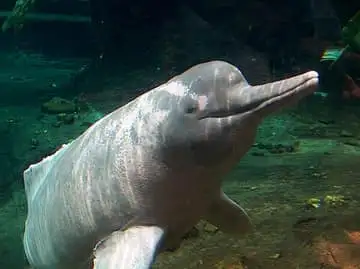
A freshwater dolphin of the Amazon, whose older males turn pinker with age. Its neck bones are not fused, so it can turn its head freely to wind between the trees of the flooded forest.
See it on the 3D globe →At a glance
- Class
- Mammals
- Diet
- Fish eater
- Weight
- about 150 kg
- Length
- about 2.3 m
- Top speed
- about 22 km/h
- Lifespan
- up to about 30 years
- Conservation status
- Endangered (IUCN EN)
- Habitat
- rivers & lakes, rainforests
Quick answers
Where does the Amazon river dolphin (boto) live?
It lives in rivers & lakes, rainforests.
How big is the Amazon river dolphin (boto)?
It grows to about 2.3 m and 150 kg.
What does the Amazon river dolphin (boto) eat?
Its diet: fish eater.
How fast is the Amazon river dolphin (boto)?
It can reach about 22 km/h.
How long does the Amazon river dolphin (boto) live?
It can live up to about 30 years.
Is the Amazon river dolphin (boto) endangered?
It is listed as Endangered (IUCN EN).
The Amazon river dolphin (Inia geoffrensis), also called the boto, bufeo or pink river dolphin, is the largest of all river dolphins. Many adult males reach about 185 kilograms and 2.5 metres in length. Adults become pink as they age, and the colour is stronger in males.
It lives in the rivers of the Amazon and Orinoco basins in South America. When the rains come, it swims into the flooded forest between the trees. Its neck bones are not fused, and its large fins let it twist and turn through tight spaces. The species is now listed as endangered, with fewer animals each year.
A dolphin in the treetops
In the rainy season, rivers rise and spill over into the forest. The Amazon river dolphin follows the water and weaves between tree trunks. Because its neck vertebrae are not fused, it can bend its head far more than most dolphins, and its big fins help it steer. Like other toothed whales, it has a rounded forehead called the melon, which it uses for echolocation, a kind of natural sonar.
Food and dangers
Boto eat up to 53 kinds of fish, including croakers, catfish, tetras and piranhas. They also eat river turtles, frogs and freshwater crabs. In 2018 the IUCN ranked them as endangered, with a falling population. Dangers include getting caught in fishing lines, being hunted for fishing bait, dams that block rivers, and pollution. Males are about 16 percent longer and 55 percent heavier than females.
Fun facts
- It swims through flooded rainforest in the rainy season, and males often turn pinker with age.
- Adult males usually turn pinker with age.
- It eats up to 53 different kinds of fish.
- Its unfused neck bones let it turn its head easily.
On the globe
The model shows an Amazon river dolphin. Look for its pink colour and long snout.
Quiz time
Which is heavier: Amazon river dolphin (boto) or Giant otter?
Show the answer
Amazon river dolphin (boto). (150 kg vs 27 kg) Giant otter →
More like this

Sources
Updated: 2026-10-14