
Capybara
카피바라
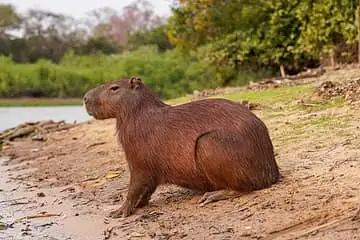
The world's largest rodent, weighing nearly 50 kg and so calm that birds often ride on its back. Its slightly webbed feet make it a strong swimmer, and it can hide underwater for several minutes.
See it on the 3D globe →At a glance
- Class
- Mammals
- Lives in
- Los Llanos, Venezuela
- Diet
- Plant eater (herbivore)
- Weight
- about 50 kg
- Length
- about 1.2 m
- Top speed
- about 35 km/h
- Lifespan
- up to about 12 years
- Conservation status
- Least Concern (IUCN LC)
- Habitat
- wetlands, grasslands, rivers & lakes
Quick answers
Where does the Capybara live?
It lives in wetlands, grasslands, rivers & lakes. On the globe you can find it near Los Llanos, Venezuela.
How big is the Capybara?
It grows to about 1.2 m and 50 kg.
What does the Capybara eat?
Its diet: plant eater (herbivore).
How fast is the Capybara?
It can reach about 35 km/h.
How long does the Capybara live?
It can live up to about 12 years.
Is the Capybara endangered?
It is listed as Least Concern (IUCN LC).
The capybara is the largest rodent alive today, a giant relative of guinea pigs. Adults are about 1.1 to 1.3 metres long and usually weigh between 35 and 66 kilograms, about as much as a grown-up person. It lives in South America, where it is found in every country except Chile, always close to rivers, lakes, ponds and marshes.
Capybaras are semi-aquatic, which means they spend their lives partly on land and partly in water. They are calm, sociable animals that live in groups, graze on grass and cool off in the water on hot days. They are famous for being so relaxed that birds often perch on their backs. Their name comes from a word in the Tupi language that roughly means "grass-eater".
Where it lives
Capybaras need water nearby. They live in savannas, wetlands, flooded grasslands such as the Llanos of Venezuela, and along the edges of rivers in forests. A group usually uses a home area of about 5 to 16 hectares. Their eyes, ears and nostrils sit high on top of the head, so they can stay almost completely underwater while still seeing, hearing and breathing. Water is also their escape route: when danger comes, they dive in and can hold their breath for up to about five minutes.
What it eats
Capybaras are herbivores, which means they eat only plants. Most of their food is grass and water plants, with some fruit and tree bark. Grass is hard to digest, so capybaras eat some of their own droppings in the morning; this lets their bodies take in the food a second time. Their front teeth and cheek teeth never stop growing, which is useful, because chewing tough grass all day wears teeth down.
Family life
Capybaras usually live in groups of about 10 to 20, and in the dry season, when water is scarce, as many as 50 to 100 may gather at the same pond. A mother is pregnant for about 130 to 150 days and has on average four babies. Jaguars, pumas, caimans and anacondas hunt capybaras, so living in a group with many watchful eyes helps keep everyone safe.
Fun facts
- It can stay underwater for up to about five minutes to hide from predators.
- A capybara can stay underwater for up to about five minutes to hide from predators.
- Its feet are slightly webbed, which makes it a strong swimmer.
- Birds such as cattle tyrants and caracaras often sit on capybaras and pick bugs off their skin.
- Male capybaras have a special scent gland on top of the snout, called a morrillo, that they use to mark their area.
- Like humans, capybaras cannot make their own vitamin C, so they must get it from their food.
On the globe
The model shows a capybara, the world's biggest rodent, in the Llanos grasslands of Venezuela. Zoom in to see its heavy, barrel-shaped body, built for grazing and swimming.
Quiz time
Which is heavier: Capybara or Kinkajou?
Show the answer
Capybara. (50 kg vs 3 kg) Kinkajou →
More like this



Sources
Updated: 2026-10-13