
Arctic hare
북극토끼
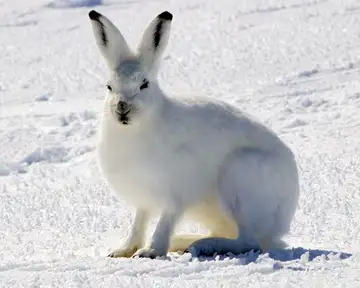
The Arctic hare is a large hare of the tundra in the Canadian Arctic and Greenland, pure white in winter apart from black ear tips. Thick fur and short ears keep it warm, and it can hop on its hind legs alone. Groups of dozens sometimes gather together.
See it on the 3D globe →At a glance
- Class
- Mammals
- Lives in
- Canadian Arctic tundra
- Diet
- Plant eater (herbivore)
- Weight
- about 4 kg
- Length
- about 0.6 m
- Top speed
- about 60 km/h
- Conservation status
- Least Concern (IUCN LC)
- Habitat
- polar regions, mountains
Quick answers
Where does the Arctic hare live?
It lives in polar regions, mountains. On the globe you can find it near Canadian Arctic tundra.
How big is the Arctic hare?
It grows to about 0.6 m and 4 kg.
What does the Arctic hare eat?
Its diet: plant eater (herbivore).
How fast is the Arctic hare?
It can reach about 60 km/h.
Is the Arctic hare endangered?
It is listed as Least Concern (IUCN LC).
The Arctic hare is a large hare built for life on the Arctic tundra and other icy places. In winter it is pure white except for black ear tips, so it is hard to see against the snow. It lives in the Canadian Arctic and Greenland. It looks like a rabbit but has shorter ears and is taller when standing.
Its small ears and short limbs, small nose, thick fur and a layer of fat close to a fifth of its body all help it keep warm. It digs holes in the ground or under the snow to sleep. It can run up to about 60 kilometres per hour. It is one of the largest living hares and rabbits, usually 43 to 70 cm long and 2.5 to 5.5 kg.
Staying warm
The Arctic hare uses its body shape to stay warm. A round body has little surface for its volume, and its fur is thick. Its metabolism is lower than expected, which saves energy in a land with little food. Its white fur hides it from predators and also reflects sunlight, which may help stop it from getting too hot in the day. When resting it curls into a nearly round shape, often among rocks, in snowdrifts or in burrows up to about 1.9 metres long.
Hares in groups
Arctic hares are usually seen alone, but they can also gather in groups, and sometimes dozens or more huddle together. They live in the northernmost parts of Greenland, the Canadian Arctic islands such as Ellesmere Island, northern Canada, and farther south in Labrador and Newfoundland. They can be found from sea level up to about 900 metres.
The name and the scientists
The Arctic hare is named for the region where it was first found. Its Latin name Lepus arcticus was given by William Elford Leach after the explorer John Ross described it in 1819. In Cree it is called meestapoos, 'large rabbit'. There are four subspecies, and its closest relatives include the broom hare and the Corsican hare. A fossil in Greenland shows it was there nearly 8,000 years ago.
Fun facts
- Arctic hares can hop on their hind legs like kangaroos and sometimes gather in groups of hundreds.
- It can hop on its hind legs like a kangaroo.
- Nearly a fifth of its body is fat.
- It can run up to about 60 km/h.
- Sometimes dozens huddle together.
On the globe
The model shows a big white tundra hare with black ear tips, as in the card. Look at its short ears.
Quiz time
Which is heavier: Arctic hare or Narwhal?
Show the answer
Narwhal. (4 kg vs 1,300 kg) Narwhal →
More like this

Sources
Updated: 2026-10-14