
Polar bear
북극곰
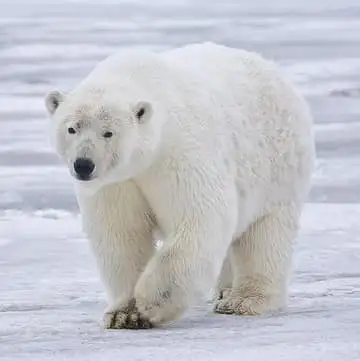
The polar bear is the largest land carnivore and hunts seals from sea ice. Its skin is black under hollow, insulating fur, and it is a strong swimmer that can cross open water for days.
See it on the 3D globe →At a glance
- Class
- Mammals
- Lives in
- Sea ice north of Svalbard, Arctic Ocean
- Diet
- Meat eater (carnivore)
- Weight
- about 380 kg
- Length
- about 2.3 m
- Top speed
- about 40 km/h
- Lifespan
- up to about 30 years
- Conservation status
- Vulnerable (IUCN VU)
- Habitat
- polar regions, coasts
Quick answers
Where does the Polar bear live?
It lives in polar regions, coasts of the Arctic Ocean. On the globe you can find it near Sea ice north of Svalbard, Arctic Ocean.
How big is the Polar bear?
It grows to about 2.3 m and 380 kg.
What does the Polar bear eat?
Its diet: meat eater (carnivore).
How fast is the Polar bear?
It can reach about 40 km/h.
How long does the Polar bear live?
It can live up to about 30 years.
Is the Polar bear endangered?
It is listed as Vulnerable (IUCN VU).
The polar bear is the largest land carnivore (meat-eater) alive today. Adult males usually weigh 300 to 800 kilograms, while females are much smaller. Polar bears live around the Arctic Ocean, in parts of Canada, Alaska, Greenland, Norway's Svalbard and Russia, and they spend much of their lives out on the frozen sea ice.
Because it depends so much on the ocean, the polar bear is counted as a marine mammal, even though it walks on land and ice. It is a powerful hunter with no natural enemies. The IUCN lists the polar bear as Vulnerable, with an estimated 22,000 to 31,000 bears in the wild. Its biggest threat is climate change: as the Arctic warms, sea ice melts earlier and forms later, giving the bears less time to hunt.
Amazing body
A polar bear looks white, but its skin underneath is black, and its guard hairs are actually clear and hollow. The hollow hairs trap heat and help the bear float, and a thick layer of fat keeps it warm. Fur even grows on the soles of its huge paws, which gives it grip on slippery ice and protects it from the cold. The front paws are slightly webbed and work like paddles, making the polar bear a strong swimmer that has been seen far out at sea.
What does it eat?
Polar bears mainly hunt seals, especially ringed seals. A bear may wait patiently beside a breathing hole in the ice, or creep along the ice edge, until a seal comes up for air. It mostly eats the seal's blubber, the thick, energy-rich fat under the skin, which helps it build up its own fat store. When seals are hard to find, polar bears also eat walruses, beluga whales or the bodies of dead whales washed up on shore. In summer, when the ice melts, many bears must wait on land with little food.
Family life
Polar bears usually live alone. A pregnant female digs a den in a deep snowdrift and gives birth there in the middle of winter, usually to twins. The cubs are born tiny and stay in the warm den for months, drinking their mother's rich milk. After they come out, they follow their mother for up to about two and a half years, learning how to hunt seals and survive the Arctic. The father does not help raise them.
Fun facts
- Under its white-looking fur, a polar bear's skin is black.
- A polar bear's guard hairs are see-through and hollow, not actually white.
- Polar bears have fur on the bottoms of their feet for grip and warmth.
- Polar bear cubs are usually born as twins in a snow den in winter.
- A polar bear's small eyes sit near the top of its head, which may help it see while swimming at the surface.
On the globe
The model shows a polar bear on the sea ice north of Svalbard in the Arctic Ocean. Look for it standing on the floating ice where it hunts seals.
Quiz time
Which is heavier: Polar bear or Arctic fox?
Show the answer
Polar bear. (380 kg vs 3.5 kg) Arctic fox →
More like this
.jpg)
Sources
Updated: 2026-10-13