
Narwhal
일각고래
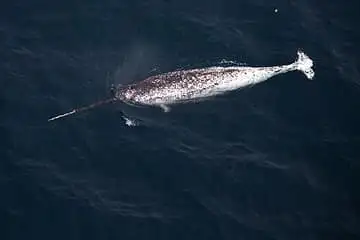
The 'unicorn of the sea' of the Arctic. A male's long spiral tusk is actually an overgrown tooth that can reach about 3 m, and narwhals dive deeper than 1,000 m to hunt.
See it on the 3D globe →At a glance
- Class
- Mammals
- Diet
- Fish eater
- Weight
- about 1,300 kg
- Length
- about 4 m
- Lifespan
- up to about 50 years
- Conservation status
- Least Concern (IUCN LC)
- Habitat
- polar regions, open ocean
Quick answers
Where does the Narwhal live?
It lives in polar regions, open ocean of the Arctic and Atlantic oceans.
How big is the Narwhal?
It grows to about 4 m and 1,300 kg.
What does the Narwhal eat?
Its diet: fish eater.
How long does the Narwhal live?
It can live up to about 50 years.
Is the Narwhal endangered?
It is listed as Least Concern (IUCN LC).
The narwhal (Monodon monoceros) is a toothed whale of the Arctic, often called the unicorn of the sea. It lives in the waters of Canada, Greenland and Russia. Adults measure 3 to 5.5 metres long and weigh about 800 to 1,600 kilograms. It has a stocky body, a blunt snout and a shallow ridge instead of a dorsal fin.
A male's long spiral tusk is actually a left canine tooth that pokes out through the lip, 1.5 to 3 metres long. Scientists think it is mainly a sign of social status, and it may also work as a weapon, a feeding tool or a sense organ. The IUCN lists the species as least concern, with an estimated 170,000 narwhals alive, but climate change, pollution and hunting are pressures on it.
A tusk full of nerves
Both sexes have a pair of teeth in the upper jaw, but in males the left one grows into the tusk, erupting from the lip at two to three years of age. The tusk is hollow, weighs up to 7.45 kilograms and keeps growing all life. Some males grow two tusks, and females rarely grow one.
The tusk is a sensory organ with millions of nerve endings that can sense changes in temperature and maybe water pressure. In 2016, drone footage in Nunavut showed narwhals tapping and stunning small Arctic cod with their tusks, which made the fish easier to catch.
Deep dives
Narwhals can dive down to 2,370 metres, among the deepest of all whales. On their winter grounds they dive at least 800 metres more than 15 times a day, and dives can last up to 25 minutes. Special slow-twitch muscles and plenty of the oxygen-storing protein myoglobin help.
They eat mainly polar and Arctic cod and Greenland halibut, as well as squid and shrimp. With almost no working teeth, they are believed to suck prey into the mouth after swimming close.
Groups, sounds and relatives
Narwhals usually gather in groups of three to eight, and in summer groups join into herds of 500 to over 1,000. They talk with clicks, whistles and knocks. They mate among offshore pack ice from March to May, and the young are born between July and August of the following year.
The beluga is the narwhal's closest relative. A strange skull found in West Greenland around 1990 was shown by DNA in 2019 to belong to a hybrid, sometimes called a narluga.
Fun facts
- The narwhal's "tusk" is really a long spiral tooth that can grow to about 3 metres.
- Narwhals and belugas can interbreed.
- The word narwhal comes from Old Norse and means corpse-whale, perhaps for its mottled skin and habit of floating still.
- Males become mature at 12 to 20 years of age, females at 8 to 9.
- Narwhal calves are born light grey, and old ones can become almost pure white.
On the globe
The model shows a male narwhal with a long spiral tusk in cold Arctic water.
Quiz time
Which is heavier: Narwhal or Arctic hare?
Show the answer
Narwhal. (1,300 kg vs 4 kg) Arctic hare →
More like this

Sources
Updated: 2026-10-14