
Muskox
사향소
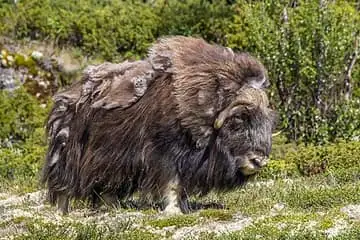
The muskox survives temperatures of -40 °C under a floor-length coat and a soft underwool called qiviut, prized as warmer than sheep's wool. When wolves come, adults form a ring around the calves.
See it on the 3D globe →At a glance
- Class
- Mammals
- Lives in
- Northeast Greenland National Park
- Diet
- Plant eater (herbivore)
- Conservation status
- Least Concern (IUCN LC)
- Habitat
- polar regions
Quick answers
Where does the Muskox live?
It lives in polar regions. On the globe you can find it near Northeast Greenland National Park.
What does the Muskox eat?
Its diet: plant eater (herbivore).
Is the Muskox endangered?
It is listed as Least Concern (IUCN LC).
The muskox (Ovibos moschatus) is a shaggy, hoofed mammal of the Arctic. It lives mainly in Greenland and the Canadian Arctic of the Northwest Territories and Nunavut, and in Alaska, where it was reintroduced. Its name comes from the strong musky smell that males give off in the breeding season, which helps attract females.
Despite the name, it is more closely related to sheep and goats than to oxen. Its Inuktitut name, umingmak, means the bearded one. Muskoxen are one of the two largest living members of the sheep-and-goat group, along with the takin. They once lived across Eurasia, where the youngest natural records are about 2,700 years old, and today there are reintroduced herds in Alaska, Yukon and Siberia, plus an introduced one in Norway.
Built for the cold
Both males and females have long, curved horns. Muskoxen stand 1.1 to 1.5 metres high at the shoulder and weigh 285 kilograms on average, within a range of 180 to 410. Their coat of black, grey and brown includes long guard hairs that almost reach the ground, and the thick coat and big head make them look larger than they really are.
Under the long hair lies a soft wool called qiviut, prized for its softness, length and warmth. Muskoxen are also able to keep their lower legs cooler than the rest of the body, which cuts the heat lost through their feet.
Herds and defence
Muskoxen live in herds of 12 to 24 in winter and 8 to 20 in summer. They do not defend territories, but they mark trails with scent glands near the eyes. Males and females each keep their own pecking order, and older animals outrank younger ones.
When the herd is threatened, the adults face outward to form a stationary ring or semicircle around the calves. The main predators are Arctic wolves, which may cause up to half of all deaths in the species. A muskox can also run at up to 60 km/h.
What it eats
In summer, muskoxen stay in wet places such as river valleys, then move to higher ground in winter to avoid deep snow. They eat grasses, Arctic willows, woody plants, lichens and mosses, and prefer juicy, nutritious grasses when there is plenty.
Willows are the most common winter food. Muskox females need a good supply of body fat before they can have a calf, a careful breeding strategy suited to a harsh land. Muskoxen usually live 12 to 20 years.
Fun facts
- When wolves approach, adults form a defensive ring around the calves with their horns facing outward.
- The Woods Cree names for the muskox translate to ugly moose and ugly bison.
- The animal survived in Eurasia until about 2,700 years ago.
- Muskox hemoglobin is three times less sensitive to temperature than human hemoglobin, which helps it work in the cold.
- Its closest living relatives appear to be the gorals of Asia, not the takin.
On the globe
The model shows a muskox with its floor-length shaggy coat and curved horns.
More like this
_male_Dovrefjell_4.jpg)
Sources
Updated: 2026-10-14