
Atlantic blue crab
대서양 꽃게(블루크랩)
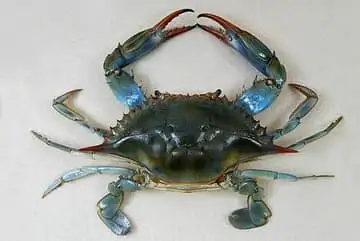
A crab whose last pair of legs are flattened into paddles, making it a strong swimmer; its scientific name means "beautiful swimmer". Males have blue claws, females red-tipped ones. It sheds its shell many times as it grows and is soft and vulnerable right after.
See it on the 3D globe →At a glance
- Class
- Crustaceans
- Diet
- Eats both plants and meat (omnivore)
- Habitat
- coasts
Quick answers
Where does the Atlantic blue crab live?
It lives in coasts of the Atlantic Ocean.
What does the Atlantic blue crab eat?
Its diet: eats both plants and meat (omnivore).
The blue crab is a swimming crab of the western Atlantic Ocean and the Gulf of Mexico, and it has also been introduced to other parts of the world. It is an important food and fishery in the United States, especially in Louisiana, the Carolinas and Chesapeake Bay. It is Maryland's state crustacean.
Its scientific name, Callinectes sapidus, means beautiful, savory swimmer. The shell can reach about 23 centimetres across. It belongs to the swimming-crab family Portunidae, and unlike most crabs it can cross open water. It is a popular seafood, and also feeds many other animals. It sheds its shell many times as it grows.
Boys and girls
Male and female blue crabs are easy to tell apart. The flap on the belly, called the apron, is long and slender in males but wide and rounded in mature females. The claws also differ in colour: males have blue claws, and females' claws have red tips. The last pair of legs is flattened into paddles, so it is a strong swimmer. Males are often called Jimmies and females Sooks, in places like Chesapeake Bay.
A changing coast
A blue crab sheds its shell many times as it grows and is soft and vulnerable right afterwards. Females need eelgrass for their final moult, so rising seas may hurt them, while warmer water may give crabs better breeding conditions and a wider range. Warmer waters might help the species spread, but nobody knows yet how a larger crab population will affect the other animals around it.
Fun facts
- Its scientific name, Callinectes sapidus, means "beautiful savory swimmer".
- Its name means 'beautiful savory swimmer'.
- Its back legs are flattened into paddles for swimming.
- Males have blue claws and females have red-tipped ones.
On the globe
The model shows a blue-clawed swimming crab. Look for it along the coasts of the Atlantic and Gulf of Mexico.
More like this

Sources
Updated: 2026-10-14