
Sally Lightfoot crab
샐리라이트풋게
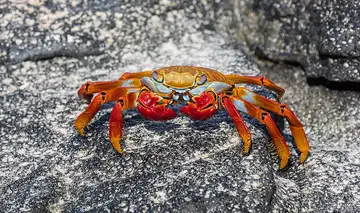
Dark as juveniles, adults turn bright red-orange and scuttle quickly over wave-splashed rocks. They graze algae and even pick ticks off marine iguanas.
See it on the 3D globe →At a glance
- Class
- Crustaceans
- Lives in
- Galápagos and rocky shores of the Pacific and Atlantic
- Diet
- Eats both plants and meat (omnivore)
- Habitat
- coasts
Quick answers
Where does the Sally Lightfoot crab live?
It lives in coasts of the Pacific and Atlantic oceans. On the globe you can find it near Galápagos and rocky shores of the Pacific and Atlantic.
What does the Sally Lightfoot crab eat?
Its diet: eats both plants and meat (omnivore).
The Sally Lightfoot crab, also called the red rock crab, is one of the most common crabs on the Pacific coast of the Americas. It has a flat, round shell a little longer than 8 centimetres, five pairs of legs and two small blocky claws. Young crabs are dark, but adults can be bright red-orange, mottled brown, pink or yellow.
This crab lives on rocks right at the edge of the sea, just above the reach of the waves' spray, in places with strong, turbulent surf. It lives along the Pacific coast of Mexico, Central America and northern South America, on islands such as the Galapagos, and also along the Atlantic coast of South America. It eats mostly algae.
Quick on its feet
Sally Lightfoot crabs walk on the tips of their broad, flat legs and move very quickly. They are agile enough to leap from rock to rock, which makes them hard to catch. Young crabs are black or dark brown, which hides them on black lava rock, but adults often turn red or orange. Charles Darwin collected this crab during the voyage of HMS Beagle, and the writer John Steinbeck described its shiny colours.
A varied diet
Algae are the main food, but the crab also eats other plants, sponges, clams, other crustaceans, fish, bird eggs and droppings, dead animals and sometimes young sea turtles. When food is scarce it can even eat other crabs. On the Galapagos, crabs have been seen picking ticks off marine iguanas, a kind of cleaning partnership. The octopus and the chain moray eel hunt this crab. Fishermen use it as bait.
Fun facts
- Young crabs are dark to hide on black lava rocks and turn bright red-orange as adults.
- Adults turn bright red or orange, but young crabs are dark to hide on black lava.
- Sally Lightfoot crabs clean ticks off marine iguanas in the Galapagos.
- They can leap from rock to rock and are hard to catch.
On the globe
The globe shows the crab on the rocky shores of the Galapagos and other Pacific and Atlantic coasts. Look for the red-orange shell on dark rock.
More like this
,_Las_Bachas,_isla_Santa_Cruz,_islas_Gal%C3%A1pagos,_Ecuador,_2015-07-23,_DD_30.jpg)
Sources
Updated: 2026-10-14