
Thresher shark
환도상어
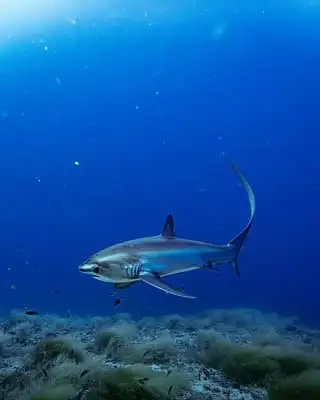
A shark famed for a tail fin as long as its body, which it whips like a lash to stun schools of small fish before eating them. It grows about 3 to 5 m long and sometimes leaps clear out of the water.
See it on the 3D globe →At a glance
- Class
- Fish
- Diet
- Fish eater
- Conservation status
- Vulnerable (IUCN VU)
- Habitat
- open ocean, coasts
Quick answers
Where does the Thresher shark live?
It lives in open ocean, coasts of the Pacific, Atlantic and Indian oceans.
What does the Thresher shark eat?
Its diet: fish eater.
Is the Thresher shark endangered?
It is listed as Vulnerable (IUCN VU).
Thresher sharks are large sharks with a tail fin as long as the rest of their body. The family Alopiidae has three living species, all in the genus Alopias, and they live in temperate and tropical oceans all around the world. They usually grow roughly 3 to 5 metres long.
The long, scythe-shaped tail is used like a whip. A thresher swims at a school of small fish and lashes its tail to stun them, then eats them. Some leap out of the water. All three species are listed as vulnerable, partly because they are caught for their meat, liver oil, skin and fins. Despite being fast hunters they are not considered a threat to people.
Where they live
Threshers prefer the open ocean, usually in water shallower than about 550 metres, though they sometimes come close to shore. The common thresher is more often seen over continental shelves, while other species stay farther out. They are mostly solitary. Because thresher sharks are caught for their meat, livers, skin and fins, and are slow to reproduce, protecting them matters. Fishers also value them as big-game sport fish.
Names and relatives
The scientific name Alopias comes from a Greek word for fox, which is why the common thresher is also called the fox shark. The English name thresher refers to the tail's resemblance to a threshing tool, and the Korean name hwando refers to a curved sword. Their closest relatives include basking sharks and great white sharks.
Fun facts
- It stuns small fish by whipping them with its very long tail.
- Its tail can be as long as its entire body.
- It stuns fish by whipping them with its tail.
- Its scientific name comes from the Greek word for fox.
- All three species are listed as vulnerable.
On the globe
On the toy globe the thresher shark swims in open ocean. Look for the very long upper tail fin.
More like this
.jpg)
Sources
Updated: 2026-10-14