
Mandarinfish
만다린피시
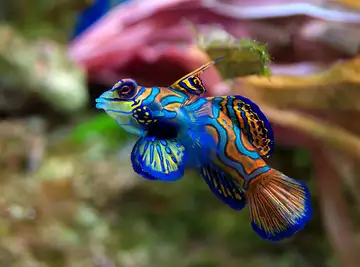
A tiny, strikingly colored fish with blue-and-orange swirls, living among coral rubble in the western Pacific. It grows to about 6 cm, has no scales, and its skin mucus tastes bad to predators. It comes out at dusk to mate.
See it on the 3D globe →At a glance
- Class
- Fish
- Lives in
- Coral reefs of Palau
- Diet
- Meat eater (carnivore)
- Length
- about 0.06 m
- Conservation status
- Least Concern (IUCN LC)
- Habitat
- coral reefs
Quick answers
Where does the Mandarinfish live?
It lives in coral reefs of the Pacific Ocean. On the globe you can find it near Coral reefs of Palau.
How big is the Mandarinfish?
It grows to about 0.06 m.
What does the Mandarinfish eat?
Its diet: meat eater (carnivore).
Is the Mandarinfish endangered?
It is listed as Least Concern (IUCN LC).
The mandarinfish, Synchiropus splendidus, also called the mandarin dragonet, is a small, brightly coloured fish of the western Pacific. It ranges from the Ryukyu Islands in the north to Australia in the south, living among coral rubble in sheltered lagoons and shallow reefs. It grows only to about 6 centimetres. Its body is bright blue with swirly orange stripes, and its face is blue-green with bold blue lines.
The common name comes from the colours, which remind people of the robes of an Imperial Chinese mandarin. It belongs to the dragonet family, Callionymidae, which has more than 180 species. It is popular in the saltwater aquarium trade, but it is a different fish from the Chinese perch also called mandarin fish. It was first described in 1927 by the American ichthyologist Albert William Herre, working in the Philippines.
A blue made by its own body
The mandarinfish is one of only two vertebrates known to have blue colour from a pigment in its cells. The other is the closely related psychedelic mandarin. In every other known case, blue in animals comes from tiny reflecting crystal structures, not from a pigment. Scientists proposed the name cyanophore for these blue pigment cells.
Different varieties have different colours: the red mandarin has red where the green form has orange, and the spotted mandarin is light grey-green with black, pink and blue spots.
Walking along the bottom
The mandarinfish has a goby-like shape, though it is not related to gobies. Its big pelvic fins are used to walk along the sea floor, and are often mistaken for the pectoral fins. The real pectoral fins sit near the middle of the body and are almost transparent. Males have an exceptionally tall dorsal fin with an orange and blue pattern.
It has no scales. Instead a layer of slime, said to be bitter and smelly, blocks disease and probably puts predators off, which suggests the bright colours are a warning.
Eating and aquariums
Mandarinfish feed continuously during the day, pecking at small animals trapped in the coral. A study of seven wild fish found harpacticoid copepods, bristle worms, small snails, amphipods, fish eggs and ostracods in their guts.
They are slow-moving and fairly common but hard to see because of their size and bottom-feeding. In aquariums they are considered difficult, because some never accept anything but live amphipods and copepods. The fish has appeared on postage stamps from Laos (1987) and Micronesia (1993).
Fun facts
- It is one of very few animals that make their own true blue colour.
- It is one of only two known vertebrates with a true blue pigment in its cells.
- It walks on the sea floor with its big pelvic fins.
- It has no scales, only a bitter slime layer.
- It has appeared on postage stamps from Laos and Micronesia.
On the globe
The model shows a tiny mandarinfish with blue-and-orange swirls among coral in the western Pacific.
Quiz time
Which is longer: Mandarinfish or Mariana snailfish?
Show the answer
Mariana snailfish. (0.06 m vs 0.29 m) Mariana snailfish →
More like this

Sources
Updated: 2026-10-14