
Bargibant's pygmy seahorse
피그미해마
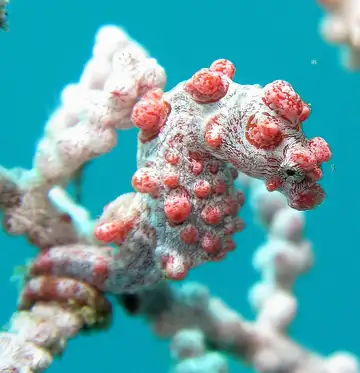
A tiny seahorse only about 2 cm long that lives on gorgonian sea fans. Its pinkish body and round tubercles match the coral polyps so closely that it was discovered only when its host coral was collected. It lives in the Coral Triangle.
See it on the 3D globe →At a glance
- Class
- Fish
- Lives in
- Coral Triangle near Komodo, Indonesia
- Diet
- Meat eater (carnivore)
- Length
- about 0.02 m
- Habitat
- coral reefs
Quick answers
Where does the Bargibant's pygmy seahorse live?
It lives in coral reefs of the Pacific Ocean. On the globe you can find it near Coral Triangle near Komodo, Indonesia.
How big is the Bargibant's pygmy seahorse?
It grows to about 0.02 m.
What does the Bargibant's pygmy seahorse eat?
Its diet: meat eater (carnivore).
Bargibant's seahorse (Hippocampus bargibanti), also called the pygmy seahorse, is one of the tiniest seahorses. It is usually less than 2 centimetres long. It lives in the central Indo-Pacific, including the Coral Triangle near Komodo in Indonesia.
It lives only on gorgonian sea fans, a kind of soft coral, and its colour and knobby bumps match the coral so closely that it is almost invisible. There are two known colour forms: grey with red bumps, and yellow with orange bumps. The seahorse does not harm the coral; the sea fan just gives it shelter. Few other animals match their background so well.
A hidden discovery
This seahorse was so well camouflaged that scientists did not know about it until 1969. A New Caledonian scientist named Georges Bargibant was collecting sea fans for a museum in Nouméa, and spotted two tiny seahorses on one as it sat on the examination table. The next year it was officially named by Whitley, in honour of Bargibant. The sea fan it lives on is a gorgonian of the genus Muricella.
Built like its coral
Big, bulb-shaped bumps called tubercles cover its body and copy the polyps of its host coral, while the body matches the stem of the sea fan. It wraps its long tail around the stem to hold on. It has a fleshy head and a very short snout. A 2025 study that read its genes estimated that it split from larger seahorses about 18.2 million years ago.
Fun facts
- Under 3 cm long, it matches its sea fan so well that it was first noticed only when a sea fan was studied in a lab.
- It is often under 2 centimetres long.
- Scientists first saw it on a sea fan in a laboratory in 1969.
- Its genome was sequenced for the first time in a 2025 study.
On the globe
The model shows a pygmy seahorse on a sea fan in the Coral Triangle near Komodo, Indonesia. Look for the pink body with round bumps.
Quiz time
Which is longer: Bargibant's pygmy seahorse or Blue tang?
Show the answer
Blue tang. (0.02 m vs 0.3 m) Blue tang →
More like this

Sources
Updated: 2026-10-14