
Barrel jellyfish
배럴해파리
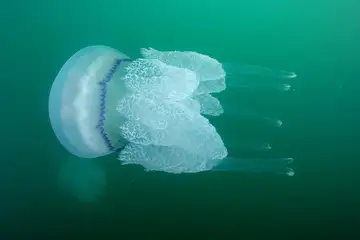
The barrel jellyfish has a white dome-shaped bell edged in purple, with a thick, frilly mass of fused oral arms hanging beneath it. The bell can reach about 60 cm across, and it has no long stinging tentacles.
See it on the 3D globe →At a glance
- Class
- Jellyfish & corals
- Lives in
- Mediterranean, Black Sea and NE Atlantic
- Diet
- Filter feeder
- Habitat
- coasts, open ocean
Quick answers
Where does the Barrel jellyfish live?
It lives in coasts, open ocean of the Atlantic Ocean. On the globe you can find it near Mediterranean, Black Sea and NE Atlantic.
What does the Barrel jellyfish eat?
Its diet: filter feeder.
The barrel jellyfish (Rhizostoma pulmo) is a big, mushroom-shaped jellyfish of the northeast Atlantic, the Mediterranean, the Black Sea and the Sea of Azov. It is also known from the southern Atlantic off western South Africa. It is also called the dustbin-lid jellyfish or the frilly-mouthed jellyfish, and it gets a lot of its character from its thick, frilly arms rather than long trailing tentacles.
In the Irish Sea it is typically up to 40 cm across, but exceptional animals reach 150 cm, which makes it the largest jellyfish in British and Irish waters. Some sources say it can weigh up to 25 kg. Compared with other jellyfish it is only moderately venomous: its sting gives people a mild burning feeling and sometimes a rash, but it is not a serious threat. It is a favourite food of leatherback turtles.
Blooms and seasons
Barrel jellyfish are usually found in late summer and early autumn, when their numbers rise into blooms. Warmer temperatures and other conditions such as wind help cause this. Scottish wildlife groups note that they gather in warmer coastal waters from late spring and often wash up on beaches in May and June, and they can be seen from May to October.
How it feeds and stings
The jellyfish eats plankton, which it takes in near the surface of shallow water. Its eight frilly arms carry the stinging cells instead of long tentacles. The sting is not normally harmful to people, but a jellyfish washed up on the beach can still sting after it has died, so it is best not to touch one. Leatherback turtles, the largest sea turtles, eat large numbers of barrel jellyfish.
Jellyfish and people
In south-east Asia, jellyfish of the same group, the rhizostomes, are used in traditional food and medicine. Scientists have studied how washing and filtering jellyfish extracts might remove toxic parts and keep useful substances that could be used in health products. The barrel jellyfish is also a reminder that names change: some sources say the animal in UK waters is a separate species from the Mediterranean one.
Fun facts
- It has no long trailing tentacles, and its sting is mild for people.
- It is the largest jellyfish in British and Irish waters.
- Its eight frilly arms look a bit like cauliflower.
- Leatherback turtles love to eat it.
- A dead one washed up on a beach can still sting.
On the globe
The model shows a big, rounded jellyfish bell with thick frilly arms, as in the card. Look at the arms underneath.
More like this
_en_mer_Noire_(Ifremer_00798-91034_-_51970).jpg)
Sources
- Read more on Wikipedia
- Rhizostoma pulmo — Wikipedia
- https://snorkel.scottishwildlifetrust.org.uk/species/barrel-jellyfish
Updated: 2026-10-14