
Lion's mane jellyfish
사자갈기해파리
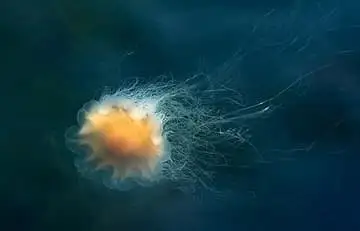
The lion's mane jellyfish is one of the largest jellyfish: its bell can pass 2 m across and its tentacles trail for tens of metres. Named for its mane-like tentacles, it lives in cold northern seas and its sting is painful.
See it on the 3D globe →At a glance
- Class
- Jellyfish & corals
- Diet
- Meat eater (carnivore)
- Habitat
- coasts, open ocean, polar regions
Quick answers
Where does the Lion's mane jellyfish live?
It lives in coasts, open ocean, polar regions of the Arctic, Atlantic and Pacific oceans.
What does the Lion's mane jellyfish eat?
Its diet: meat eater (carnivore).
The lion's mane jellyfish (Cyanea capillata) is one of the largest known jellyfish. It lives in cold northern waters of the Arctic, North Atlantic and North Pacific, and it is common in the North Sea and around Scandinavia. Look for it in the English Channel, the Irish Sea and the North Sea.
It is named for its long, trailing tentacles that look like a lion's mane. The biggest one on record, found off Massachusetts in 1865, had a bell 2.1 metres across and tentacles about 36.6 metres long, which is longer than a blue whale. Its sting is painful.
Built like a star
The bell of most jellyfish is round, but the lion's mane has a bell divided into eight lobes, like an eight-point star. Each lobe holds about 70 to 150 tentacles in four fairly clear rows.
Young jellyfish are light orange or tan and darken to red and purple as they age. A jellyfish at lower latitudes is usually smaller, with a bell about 50 centimetres across.
Drifting through the sea
Most live in the top 20 metres of the sea and drift with the currents, each one moving alone rather than in a group. They are seen most often in late summer and autumn.
They use their tentacles to catch fish and plankton. In the eastern North Atlantic a smaller, blue relative, Cyanea lamarckii, lives alongside it. Some zoologists even think all the Cyanea species could be one, so the family tree is still being worked out. The jellyfish can also drift outside its usual waters during warm spells, even into the southwestern Baltic Sea, though it cannot breed there because the water is not salty enough.
Fun facts
- Its longest tentacles can be longer than a blue whale.
- The longest tentacles on record were about 36.6 metres, longer than a blue whale.
- The bell has eight lobes, like a star.
- The biggest bell measured 2.1 metres across.
- It is also called the hair jelly or the arctic red jellyfish.
On the globe
The model shows a lion's mane jellyfish with its mane of trailing tentacles in the cold northern sea.
More like this

Sources
Updated: 2026-10-14