
Red coral
붉은산호
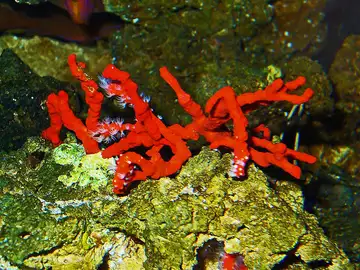
The red coral forms small branching colonies about 10 to 30 cm tall, built on a hard red skeleton that has been used for jewellery since ancient times. It grows in the dim crevices and caves of Mediterranean rocky reefs.
See it on the 3D globe →At a glance
- Class
- Jellyfish & corals
- Lives in
- Rocky seabed of the western Mediterranean and nearby Atlantic
- Diet
- Filter feeder
- Habitat
- coral reefs, caves
Quick answers
Where does the Red coral live?
It lives in coral reefs, caves of the Atlantic Ocean. On the globe you can find it near Rocky seabed of the western Mediterranean and nearby Atlantic.
What does the Red coral eat?
Its diet: filter feeder.
Red coral, also called precious coral, belongs to the genus Corallium. It is an animal, not a plant or a rock. Each colony looks like a small leafless bush made of many tiny polyps that can pull back into a hard red skeleton. People have used that skeleton for jewellery since ancient times.
The best-known species, Corallium rubrum, lives mainly in the Mediterranean Sea and in the nearby Atlantic, for example near the Strait of Gibraltar, the Cape Verde Islands and southern Portugal. It grows on rocky seabed where little mud settles and where it is dark, in deep water or in caves and crevices. Other Corallium species live in the western Pacific, around Japan and Taiwan.
A bush made of tiny animals
Red corals are octocorals, which means each polyp has eight arms. Wikipedia describes colonies as small bushes that can grow up to about a metre tall, although the card on the globe describes typical colonies of 10 to 30 centimetres. The hard skeleton is made of calcium carbonate and coloured red by natural pigments. Over it lies a soft red layer from which white polyps stick out. In the Mediterranean the coral grows from about 10 to 300 metres deep, and in the caves near Alghero in Sardinia from 4 to 35 metres.
Coral and people
Red coral has been harvested since antiquity. Coral jewellery has been found in ancient Egyptian graves and in prehistoric burials in Europe. The Roman writer Pliny the Elder noted that people in India prized it highly, and Romans hung branches around children's necks to protect them. It measures 3.5 on the Mohs hardness scale, so it is soft enough to be polished into beads and cabochons. Shallow Mediterranean beds have been largely emptied by harvesting.
Fun facts
- Its red skeleton has been made into jewellery since ancient times.
- Red coral is soft by gemstone standards, about 3.5 on the Mohs scale.
- The word coral is also used for a colour, the name of the warm reddish pink seen in this skeleton.
- Pacific species of Corallium live far deeper than Mediterranean ones, at 350 to 1,500 metres.
On the globe
The globe shows red coral on the rocky seabed of the western Mediterranean. Look for small branching red colonies.
More like this

Sources
Updated: 2026-10-14