
Portuguese man o' war
고깔해파리
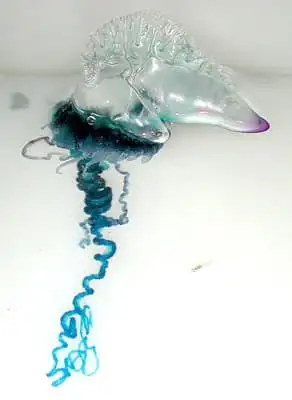
It looks like a jellyfish but is really a colony of tiny specialised animals living as one. Its blue float rides the wind on the surface, and its trailing tentacles, often over 10 m long, sting fish with venom.
See it on the 3D globe →At a glance
- Class
- Jellyfish & corals
- Diet
- Meat eater (carnivore)
- Habitat
- open ocean
Quick answers
Where does the Portuguese man o' war live?
It lives in the open ocean of the Atlantic, Pacific and Indian oceans.
What does the Portuguese man o' war eat?
Its diet: meat eater (carnivore).
The Portuguese man o' war, Physalia physalis, looks like a jellyfish, but it is really a siphonophore: a colony of many tiny specialised animals called zooids that live and work together as one. It floats on the surface of the Atlantic, Indian and Pacific oceans. A gas-filled float called the pneumatophore keeps it afloat, while its tentacles, sometimes up to 30 metres long, hang below and carry venomous stinging cells.
Because it lives on the surface of the water, it belongs to a group of organisms called the neuston. A sail on the float catches the wind and carries it across the sea, sometimes in groups as large as 1,000. Its sting is strong enough to kill fish and crustaceans, and in rare cases humans. It is also called the bluebottle, and in Portuguese Caravela Portuguesa.
One animal made of many
All the zooids in one man o' war grow from a single fertilised egg, so they are genetically identical, yet they look different and do different jobs, such as hunting, digestion and reproduction. Seven types of zooid have been described. They cannot live apart, and from an ecological view the colony is one animal, though from an embryo's view it is many.
A young colony starts as a larva that first grows the float and a single feeding zooid, then adds more feeders and tentacle zooids. Each colony is either male or female, and the eggs and sperm are released straight into the water. Scientists have not yet seen the early stages in the wild.
Friends and foes
The man o' war is a carnivore. It paralyses small fish, molluscs and zooplankton with its tentacles and reels them in. Few animals eat it. The loggerhead sea turtle does, because its skin is too thick for the stings. The blue sea slug, the violet sea snail and the ocean sunfish also eat it.
The man-of-war fish lives among the tentacles, avoiding stings by swimming carefully, and may even lure other fish for the colony. The blanket octopus is immune to the venom and carries pieces of tentacle to use as weapons.
Sails, stings and beaches
The float is filled with a mix of carbon monoxide and air and works as a sail. The wind pushes it, and it can drift thousands of miles. The sail can be left-handed or right-handed, according to which way the wind catches it. Near the coast, currents can wash large numbers ashore.
Stings cause severe pain lasting one to three hours and red welts that last for days. Dead ones on beaches and detached tentacles can sting for hours or even days. In rare cases the venom causes serious symptoms, so people with trouble breathing need medical help.
Fun facts
- It is not a single animal but a colony of specialised individuals called zooids.
- It is a colony of animals, not a single animal.
- Its tentacles can be as long as 30 metres.
- A stranded man o' war can still sting for hours or days.
- The loggerhead turtle can eat it because its skin is too thick to be stung.
On the globe
The model shows a Portuguese man o' war with a blue float and trailing tentacles on the open sea.
More like this
.jpg)
Sources
Updated: 2026-10-14