
Moon jelly
보름달물해파리
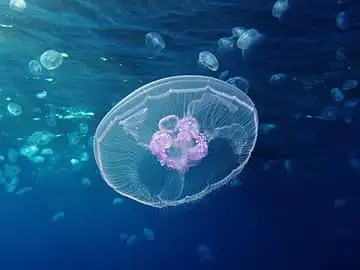
A see-through jellyfish with four horseshoe-shaped rings showing on top, and a body that is about 95 percent water. It has no brain, heart or bones, yet it sweeps tiny plankton to its mouth and thrives even in cold seas.
See it on the 3D globe →At a glance
- Class
- Jellyfish & corals
- Diet
- Meat eater (carnivore)
- Lifespan
- up to about 1 years
- Habitat
- coasts, open ocean
Quick answers
Where does the Moon jelly live?
It lives in coasts, open ocean of the Pacific, Atlantic and Indian oceans.
What does the Moon jelly eat?
Its diet: meat eater (carnivore).
How long does the Moon jelly live?
It can live up to about 1 years.
Moon jellies are see-through jellyfish of the genus Aurelia. You can spot them by four horseshoe-shaped rings glowing through the top of the bell. They float in the Atlantic, Arctic, Pacific and Indian Oceans, and are especially common in temperate waters such as those off Japan, Korea, New Zealand and northern Europe.
Like other jellyfish, a moon jelly has no brain, heart or bones, and its body is about 95 percent water. Scientists have studied this group a lot, and DNA studies show there are more species than anyone guessed from looks alone. They drift in coastal and open ocean waters, and their pale bell is thin and almost clear. Most people who touch one feel little or no sting.
Stings and food
Moon jellies lack long, strong stinging tentacles. Instead hundreds of short, fine tentacles line the edge of the bell, and their sting is mild for most people. They drift and feed on tiny plankton, which they sweep toward their mouths. A bell usually measures 5 to 38 centimetres across. Their short tentacles also help move food to the mouth. Because the bell is so watery, a moon jelly is mostly a thin, floating cloud of jelly.
A life in two forms
Moon jellies change shape during life. The free-swimming adult jellyfish, either male or female, reproduces sexually. The baby stage, a tiny polyp stuck to the seafloor, makes new jellyfish without a partner. Because several species look nearly identical, they are hard to tell apart. Scientists have found that what looks like one species may actually be several, so careful DNA studies help sort them out.
Fun facts
- Like other jellyfish, it has no brain, heart or bones, and its body is about 95% water.
- There are 25 accepted moon jelly species, with many more not yet described.
- The genus was first described in 1816 by Jean-Baptiste Lamarck.
- Moon jellies are among the best-studied jellyfish.
On the globe
The model shows a translucent moon jelly with four rings visible on top of its bell.
More like this

Sources
Updated: 2026-10-14