
Compass jellyfish
컴퍼스해파리
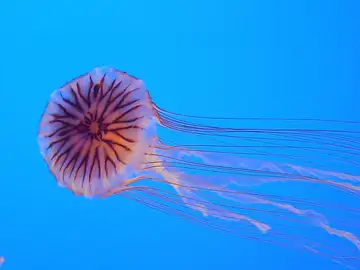
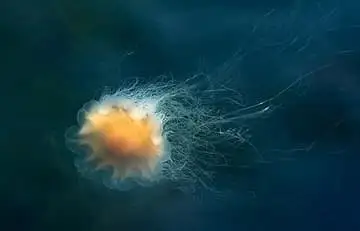
The compass jellyfish has a pale golden bell marked with 16 brown stripes that radiate like the points of a compass. Its bell grows to about 30 cm across, and the long trailing tentacles can give a painful sting.
See it on the 3D globe →At a glance
- Class
- Jellyfish & corals
- Lives in
- North Sea, English Channel and NE Atlantic
- Diet
- Meat eater (carnivore)
- Habitat
- coasts, open ocean
Quick answers
Where does the Compass jellyfish live?
It lives in coasts, open ocean of the Atlantic Ocean. On the globe you can find it near North Sea, English Channel and NE Atlantic.
What does the Compass jellyfish eat?
Its diet: meat eater (carnivore).
The compass jellyfish (Chrysaora hysoscella) is a common jellyfish of coastal waters in the temperate northeastern Atlantic, including the North Sea and the Mediterranean. Its pale yellowish-white bell, usually 15 to 25 centimetres across, usually bears 16 brown, V-shaped marks that spread out from a brown spot at the centre.
Those stripes look like the markings on a compass, which gives the animal its name. Its 24 tentacles grow in eight groups of three, and four frilly oral arms carry food to its mouth. The sting can be painful. Young jellyfish do not yet have the pattern: they look white with a reddish edge and are covered in dots.
How does it eat?
The jellyfish uses its tentacles, full of stinging cells, to catch small marine invertebrates and plankton. The longer, frilly oral arms then pass the food to the mouth in the middle of the underside of the bell. A sense organ between each group of tentacles can detect changes in light and helps the jellyfish stay at the right depth. Very few animals eat compass jellyfish.
From polyp to jellyfish
Like many jellies, this species has two shapes in its life. First it is a small polyp fixed to the sea floor, and later it turns into the floating medusa we see. Older reports from South Africa were mistakes, caused by confusing it with close relatives. Large blooms of jellyfish can disturb beaches, fishing and fish stocks, which makes them a concern for people.
Fun facts
- It is named for the brown V-shaped marks on its bell, which look like the points of a compass.
- It usually has 16 brown marks like a compass face.
- Its 24 tentacles grow in eight groups of three.
- Young jellyfish are white and spotted, with no compass pattern.
- Few animals eat it.
On the globe
The model floats in the coastal Atlantic. Look for the brown V-shaped stripes on its pale bell.
More like this

Sources
Updated: 2026-10-14