
Blue shark
청상어
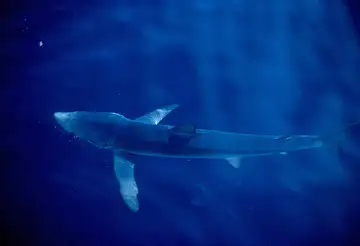
The blue shark is a slender shark with an indigo-blue back, white belly and very long, scythe-like pectoral fins. About 3 m long, it migrates thousands of kilometres across oceans, feeding on squid and small fish.
See it on the 3D globe →At a glance
- Class
- Fish
- Lives in
- Temperate and tropical oceans worldwide
- Diet
- Meat eater (carnivore)
- Length
- about 2.5 m
- Conservation status
- Near Threatened (IUCN NT)
- Habitat
- open ocean
Quick answers
Where does the Blue shark live?
It lives in the open ocean of the Pacific, Atlantic and Indian oceans. On the globe you can find it near Temperate and tropical oceans worldwide.
How big is the Blue shark?
It grows to about 2.5 m.
What does the Blue shark eat?
Its diet: meat eater (carnivore).
Is the Blue shark endangered?
It is listed as Near Threatened (IUCN NT).
The blue shark is a slim, indigo-blue shark that lives in deep temperate and tropical oceans around the world. It prefers cooler water between about 12 and 20 degrees Celsius and is found off every continent except Antarctica. It lives from the surface down to about 350 metres.
It averages about 3.1 metres long, and it is famous for long migrations. For example, it can travel from New England to South America. The IUCN lists it as Near Threatened. The species is the only living member of its genus, Prionace, and it has an extinct relative whose teeth were found in California.
What does it eat?
Blue sharks feed mainly on small fish and squid, though they can take larger prey. They look lazy but can move very fast when they want. Their own enemies include killer whales and bigger sharks such as the tiger shark and the great white. Their pointed, scythe-like fins give them a distinctive shape. The indigo upper body fades to a white belly.
Baby sharks and bycatch
Blue sharks are viviparous, so they give birth to live pups, and a litter is large, from 25 to over 100 pups. Their maximum lifespan is not known for sure, but they may live up to about 20 years. They are one of the most abundant open-ocean sharks, and many are caught accidentally on longlines and nets. Fossil blue shark teeth have been found in Sri Lanka, Chile and Italy, so the species has been around for millions of years. Because they are caught so often, scientists monitor the population closely.
Fun facts
- Blue sharks make some of the longest journeys of any shark, crossing whole oceans.
- A blue shark can swim all the way from New England to South America.
- Mothers may have more than 100 pups in one litter.
- Its main foods are small fish and squid.
On the globe
The model shows a long, slim, blue shark with long side fins. Look for it in the open ocean.
Quiz time
Which is longer: Blue shark or Atlantic bluefin tuna?
Show the answer
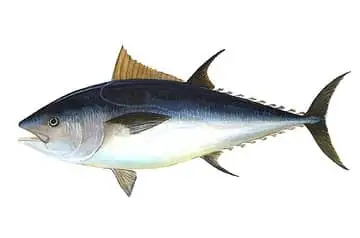
Blue shark. (2.5 m vs 2 m) Atlantic bluefin tuna →
More like this

Sources
Updated: 2026-10-14