
Bearded seal
수염물범

A large seal with long, dense white whiskers and square foreflippers. It can weigh nearly 300 kg and feels along the seabed with its whiskers for clams and crabs. Males sing long trilling songs underwater.
See it on the 3D globe →At a glance
- Class
- Mammals
- Lives in
- Arctic Ocean, Laptev & East Siberian Seas
- Diet
- Meat eater (carnivore)
- Length
- about 2.4 m
- Conservation status
- Near Threatened (IUCN NT)
- Habitat
- polar regions
Quick answers
Where does the Bearded seal live?
It lives in polar regions of the Arctic, Pacific and Atlantic oceans. On the globe you can find it near Arctic Ocean, Laptev & East Siberian Seas.
How big is the Bearded seal?
It grows to about 2.4 m.
What does the Bearded seal eat?
Its diet: meat eater (carnivore).
Is the Bearded seal endangered?
It is listed as Near Threatened (IUCN NT).
The bearded seal is a medium-sized seal of the Arctic Ocean and nearby sub-Arctic seas. It is also called the square-flipper seal. Its scientific name Erignathus barbatus refers to its heavy jaw and its beard, the thick, abundant whiskers that curl elegantly when dry. It is the largest northern true seal, with females slightly bigger than males.
Adults are about 2.1 to 2.7 metres long and weigh 200 to 430 kg. Their coat is greyish-brown, darker on the back, and their foreflippers are square. They are found along the Arctic coasts of Russia, Norway, Canada and Alaska, including Svalbard, and in the Pacific from the Chukchi Sea to the Bering Sea and the Sea of Okhotsk. A few stray seals have been seen as far south as Japan, Spain and Portugal.
Hunting on the seafloor
Bearded seals feed mostly on the bottom. They eat clams, squid, crustaceans and fish such as plaice, sculpins and Arctic cod, as well as anemones, sea cucumbers and worms. They use their whiskers as feelers in the soft mud. Adults like shallow coastal water less than 300 metres deep, though pups under a year old have dived to 450 metres.
Pups and songs
Pups are born in spring, in April and May, on small drifting ice floes in shallow water. They weigh 30 to 40 kg at birth and swim within hours. For 18 to 24 days they drink about 8 litres of milk a day, gaining 3.3 kg a day, and reach about 100 kg when weaned. In the breeding season males sing underwater, a long oscillating trill that lasts a minute or more and ends in a short moan. The trills can be heard from more than 30 kilometres away.
Dangers and delayed pregnancy
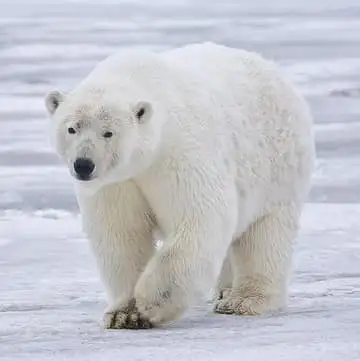
Polar bears hunt bearded seals, usually pups up to about two years old, and killer whales also eat them, sometimes tipping ice floes to reach them. The seals use delayed implantation, so the fertilised egg waits about two months before settling, and the whole pregnancy lasts about eleven months. Bearded seals are believed to live up to 31 years, and they are protected in the United States under the Marine Mammal Protection Act.
Fun facts
- In the breeding season males sing long, spiralling trills underwater.
- Its square flippers give it the nickname square-flipper seal.
- Males sing long, spiralling trills underwater that carry over 30 km.
- A pup swims just hours after birth.
- A pregnancy lasts about eleven months because the egg waits before settling.
On the globe
The model shows a seal with thick whiskers and square flippers, as in the card. Look at the whiskers.
Quiz time
Which is longer: Bearded seal or Arctic fox?
Show the answer
Bearded seal. (2.4 m vs 0.85 m) Arctic fox →
More like this




Sources
Updated: 2026-10-14