
Ringed seal
고리무늬물범
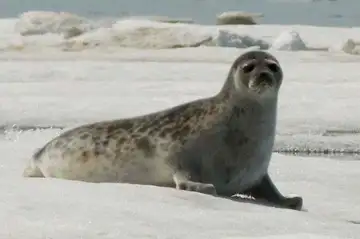
The smallest and most common Arctic seal, grey with scattered pale ring-shaped marks. It keeps breathing holes open in the sea ice with its strong claws, and it is the main prey of polar bears.
See it on the 3D globe →At a glance
- Class
- Mammals
- Lives in
- Arctic Ocean, Svalbard & Fram Strait
- Diet
- Fish eater
- Weight
- about 60 kg
- Length
- about 1.4 m
- Conservation status
- Least Concern (IUCN LC)
- Habitat
- polar regions
Quick answers
Where does the Ringed seal live?
It lives in polar regions of the Arctic, Pacific and Atlantic oceans. On the globe you can find it near Arctic Ocean, Svalbard & Fram Strait.
How big is the Ringed seal?
It grows to about 1.4 m and 60 kg.
What does the Ringed seal eat?
Its diet: fish eater.
Is the Ringed seal endangered?
It is listed as Least Concern (IUCN LC).
The ringed seal is the smallest and most common seal of the Arctic. It has a small head, a short cat-like snout and a plump body. Its dark coat is marked with silver rings on the back and sides, with a silvery belly, which gives the animal its name. It is usually about 1.5 metres long and weighs 50 to 70 kilograms.
It lives throughout the Arctic Ocean and its edges, including the Bering Sea, the Sea of Okhotsk, Greenland, Scandinavia and the Baltic Sea. Two small groups live in lakes in northern Europe. It lives alone, feeds mostly on Arctic cod and small floating crustaceans, and can live for about 40 years. The globe places it near Svalbard and the Fram Strait.
A seal with claws
Ringed seals live on sea ice, and they cannot rely on open water in winter. Their small front flippers have strong, thick claws, more than 2.5 centimetres long, that they use to scratch and keep breathing holes open in ice up to 1.8 metres thick. Mothers raise pups in snow caves on the ice, where they are hidden from predators. The seal is a key prey of polar bears and orcas, and Arctic peoples have hunted it for a long time.
Ice in danger
The biggest threat to ringed seals is climate change, because warmer air and water reduce sea ice and the snow on top of it. Without enough snow, the caves where pups are born cannot form properly. Some scientists believe that if polar bears died out first, ringed seals might do better, but this is a projection and not a fact. The species is still common, and the IUCN lists it as Least Concern.
Fun facts
- It is the main prey of polar bears and raises its pups in snow caves on the sea ice.
- Its claws are over 2.5 centimetres thick and keep breathing holes open in thick ice.
- It is the main food of polar bears.
- Two groups of ringed seals live in lakes, in Finland and Russia.
On the globe
The globe places the ringed seal in the Arctic Ocean near Svalbard and the Fram Strait. Look for the grey coat with pale ring marks.
Quiz time
Which is heavier: Ringed seal or Arctic fox?
Show the answer
Ringed seal. (60 kg vs 3.5 kg) Arctic fox →
More like this

Sources
Updated: 2026-10-14