
Lemon shark
레몬상어
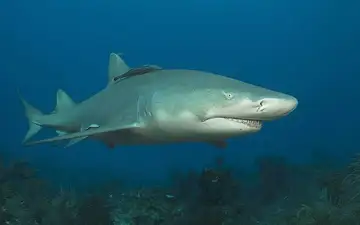
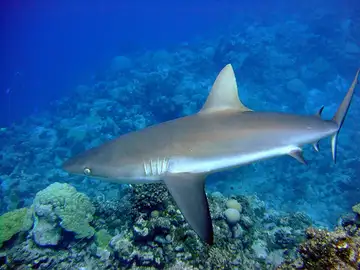
A yellow-brown shark with two dorsal fins of nearly equal size. Young lemon sharks grow up in shallow mangrove lagoons, and adults reach about 3 m. The shallow lagoons of Moorea and the Bahamas are well-known study sites.
See it on the 3D globe →At a glance
- Class
- Fish
- Lives in
- Lagoons of Moorea, French Polynesia
- Diet
- Meat eater (carnivore)
- Weight
- about 90 kg
- Length
- about 2.7 m
- Conservation status
- Vulnerable (IUCN VU)
- Habitat
- coasts, coral reefs
Quick answers
Where does the Lemon shark live?
It lives in coasts, coral reefs of the Atlantic and Pacific oceans. On the globe you can find it near Lagoons of Moorea, French Polynesia.
How big is the Lemon shark?
It grows to about 2.7 m and 90 kg.
What does the Lemon shark eat?
Its diet: meat eater (carnivore).
Is the Lemon shark endangered?
It is listed as Vulnerable (IUCN VU).
The lemon shark (Negaprion brevirostris) is a requiem shark with yellowish-brown skin, which gives it its name. Adults usually reach about 2.4 to 3.1 metres long and up to about 90 kilograms, and the largest ever measured was 3.43 metres. It lives in warm, shallow coastal waters of the Atlantic and Pacific. It is often found in shallow subtropical waters.
It has a flat head, a short, broad snout and two dorsal fins of nearly the same size. The IUCN lists it as vulnerable. Lemon sharks are not seen as a big danger to people: only about 10 bites have been recorded, and none was life-threatening.
Nurseries and night hunting
Female lemon sharks give birth to live young, and the pups stay in special nursery areas such as shallow mangrove lagoons. The sharks return to these nursery sites to breed, and Moorea and the Bahamas are well-known study sites.
Lemon sharks often feed at night. Their heads hold electroreceptors, called the ampullae of Lorenzini, that sense the tiny electric signals made by fish, which are their main prey.
Life in a group
Lemon sharks enjoy living in groups, which helps them communicate, court, hunt and stay safe.
The yellow colour is a handy disguise when swimming over a sandy seabed. No one knows exactly how long they live, but typical sharks are 25 to 30 years old, and in 2023 the oldest lemon shark in captivity died at age 40. It is a requiem shark in the family Carcharhinidae.
Fun facts
- It is named for its yellowish skin, which blends in over sandy seabeds.
- Its yellowish skin blends in with sandy seafloors.
- Its two dorsal fins are almost the same size.
- Only about 10 lemon shark bites on people have ever been recorded.
- The oldest lemon shark in captivity lived to be 40.
On the globe
The model shows a yellow-brown lemon shark in the shallow lagoons of Moorea, a famous study site.
Quiz time
Which is heavier: Lemon shark or Bull shark?
Show the answer
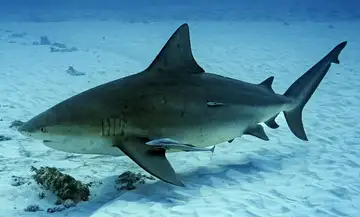
Bull shark. (90 kg vs 110 kg) Bull shark →
More like this

Sources
Updated: 2026-10-14