
Cuban crocodile
쿠바악어
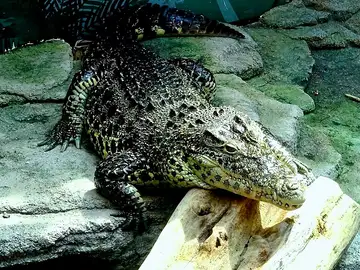
A compact, robust crocodile found only in Cuba, in the Zapata Swamp and Isla de la Juventud. Its dark body is marked with yellow patches, and its relatively long legs make it quick on land. Only a few thousand remain in the wild.
See it on the 3D globe →At a glance
- Class
- Reptiles
- Lives in
- Zapata Swamp, Cuba
- Diet
- Meat eater (carnivore)
- Weight
- about 75 kg
- Length
- about 2.2 m
- Conservation status
- Critically Endangered (IUCN CR)
- Habitat
- wetlands, rivers & lakes
Quick answers
Where does the Cuban crocodile live?
It lives in wetlands, rivers & lakes. On the globe you can find it near Zapata Swamp, Cuba.
How big is the Cuban crocodile?
It grows to about 2.2 m and 75 kg.
What does the Cuban crocodile eat?
Its diet: meat eater (carnivore).
Is the Cuban crocodile endangered?
It is listed as Critically Endangered (IUCN CR).
The Cuban crocodile is a small to medium-sized crocodile found only in Cuba. It is compact and robust, with a dark body marked with yellow patches. A typical adult is 2.1 to 2.3 metres long and weighs 70 to 80 kilograms, but big males can reach 3.5 metres and more than 215 kilograms.
It has unusually long, strong legs, which makes it the most land-based of all living crocodiles. It is quick on land and very territorial. It is listed as Critically Endangered: today it survives only in the Zapata Swamp and on Isla de la Juventud, and only a few thousand remain.
Where does it live and eat?
It prefers freshwater and brackish places such as mangrove swamps, coastal lagoons, estuaries, marshes, floodplains and river deltas. Adults eat fish, turtles and small mammals, while the young eat invertebrates and smaller fish. Mating happens between May and July. Captive crocodiles have shown cooperative hunting and can be taught tricks, which suggests they are clever. Cuban crocodiles are among the most territorial of all crocodiles and can be dangerous to people, so wildlife experts keep a safe distance.
Rescuing the species
Long ago the species lived across the Caribbean. Fossils have been found in the Bahamas, Hispaniola and the Cayman Islands. Hunting by humans shrank its range to a small area. Captive breeding projects are helping it recover. It is the most heavily armoured living member of its genus, with rough, 'pebbled' scales and brighter adult colours than its relatives. Protecting the Zapata Swamp, its last stronghold, is one of the best ways to keep this reptile from disappearing.
Fun facts
- Most wild Cuban crocodiles live in a single place, Cuba's Zapata Swamp.
- Most wild Cuban crocodiles live in a single place, the Zapata Swamp.
- It is the most land-living of the living crocodiles.
- Captive animals have shown cooperative hunting.
- Fossils show it once lived in the Bahamas and the Cayman Islands.
On the globe
The model is in the swamps of Cuba. Look for the dark body with yellow patches and long legs.
Quiz time
Which is heavier: Cuban crocodile or American alligator?
Show the answer
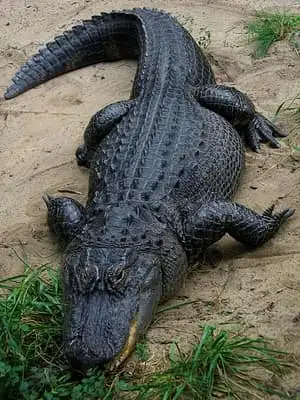
American alligator. (75 kg vs 230 kg) American alligator →
More like this

Sources
Updated: 2026-10-14