
Leatherback sea turtle
장수거북
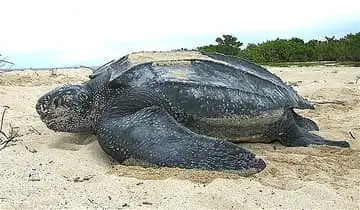
The largest sea turtle, growing nearly 2 m long and over 500 kg. Instead of a hard shell it has leathery skin, feeds mainly on jellyfish, and can dive deeper than 1,000 m.
See it on the 3D globe →At a glance
- Class
- Reptiles
- Diet
- Meat eater (carnivore)
- Weight
- about 480 kg
- Length
- about 2 m
- Top speed
- about 35 km/h
- Lifespan
- up to about 50 years
- Conservation status
- Vulnerable (IUCN VU)
- Habitat
- open ocean
Quick answers
Where does the Leatherback sea turtle live?
It lives in the open ocean of the Pacific, Atlantic and Indian oceans.
How big is the Leatherback sea turtle?
It grows to about 2 m and 480 kg.
What does the Leatherback sea turtle eat?
Its diet: meat eater (carnivore).
How fast is the Leatherback sea turtle?
It can reach about 35 km/h.
How long does the Leatherback sea turtle live?
It can live up to about 50 years.
Is the Leatherback sea turtle endangered?
It is listed as Vulnerable (IUCN VU).
The leatherback sea turtle (Dermochelys coriacea) is the largest living turtle and the heaviest reptile except for crocodilians. Adults can reach lengths of up to 2.7 metres and weigh around 500 kilograms. It lives in oceans all over the world, travelling long distances in search of food.
Unlike other sea turtles, it has no hard bony shell. Its back is covered by oily flesh and flexible, leather-like skin, which is where its name comes from. The species as a whole is listed as vulnerable, and some groups of leatherbacks are critically endangered.
What does it eat and how deep can it dive?
Jellyfish are the leatherback's most important food, though it also eats sea squirts, squid, octopus and sometimes small fish. It is a champion diver and can go down as deep as 1,280 metres.
Because it follows jellyfish into cold water, it has one of the widest ranges of any sea turtle, and it manages to keep its body temperature steady during long journeys.
A very old kind of turtle
Relatives of modern leatherbacks have looked much the same for a very long time, since the first true sea turtles appeared more than 110 million years ago, in the Cretaceous period.
The name lute turtle comes from the seven ridges that run along its back, which people compared to the strings of a lute. Today egg collecting, ship strikes and fishing nets have caused big drops in numbers, especially in the Pacific, so conservation matters a lot.
Fun facts
- Jellyfish are its main food, and backward-pointing spines in its throat help it swallow them.
- The leatherback is the largest of all living turtles.
- Its shell is leathery skin instead of hard bone.
- It can dive to about 1,280 metres deep.
- Seven ridges on its back inspired the nickname lute turtle.
On the globe
The model shows a large leatherback sea turtle with its smooth, ridged back, swimming in the open ocean.
Quiz time
Which is heavier: Leatherback sea turtle or Green anaconda?
Show the answer
Leatherback sea turtle. (480 kg vs 55 kg) Green anaconda →
More like this
.jpg)
Sources
Updated: 2026-10-14