
Green iguana
녹색이구아나
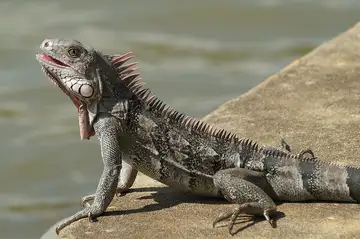
A large leaf-eating lizard of Central and South America. It has a crest of spines along its back, a big dewlap under the throat and a banded tail; adults reach about 1.5 m and are good swimmers that drop from trees into water.
See it on the 3D globe →At a glance
- Class
- Reptiles
- Lives in
- Forests and riverbanks of Central America
- Diet
- Plant eater (herbivore)
- Weight
- about 4 kg
- Length
- about 1.5 m
- Lifespan
- up to about 20 years
- Conservation status
- Least Concern (IUCN LC)
- Habitat
- rainforests, forests
Quick answers
Where does the Green iguana live?
It lives in rainforests, forests. On the globe you can find it near Forests and riverbanks of Central America.
How big is the Green iguana?
It grows to about 1.5 m and 4 kg.
What does the Green iguana eat?
Its diet: plant eater (herbivore).
How long does the Green iguana live?
It can live up to about 20 years.
Is the Green iguana endangered?
It is listed as Least Concern (IUCN LC).
The green iguana is a large lizard that spends most of its life in trees. It can grow to about 1.7 metres from head to tail, though a few have passed two metres. It has a row of spines along its back, a loose flap of skin called a dewlap under the throat, and a banded tail.
It is native to a wide area from Mexico down to southern Brazil and Paraguay, and it lives in forests and along riverbanks. Unlike most lizards it is mostly a herbivore, eating leaves, flowers and fruit. Scientists think the species first arose in South America and later spread to Central America and the Caribbean.
A tree-top swimmer
Green iguanas bask on branches high above water. When danger comes, they may simply drop into the river below and swim away, using their long, flat tails like paddles.
A light-sensing spot on the top of their head, sometimes called a third eye, helps them notice shadows of predators passing above. It also uses its strong claws to climb, and its long toes grip bark well.
Iguanas around the world
Because they are bright, calm and easy to find, green iguanas are popular pets. They are not easy pets, though: they need lots of space, special lighting and heat.
Some escaped or released iguanas have started to live in warm places far from home, such as Florida and Hawaii, where scientists consider them invasive. Like many reptiles, it needs heat from the sun to keep its body warm and to digest its food.
Fun facts
- A light-sensing "third eye" on top of its head helps it notice predators from above.
- It eats mostly plants, which is unusual for a lizard.
- It can jump from tree to water and swim well.
- A pale spot on top of its head senses light and shadow.
On the globe
The globe places the green iguana in the forests and riverbanks of Central America. Look for the spiny crest and the banded tail.
Quiz time
Which is heavier: Green iguana or Cuban crocodile?
Show the answer
Cuban crocodile. (4 kg vs 75 kg) Cuban crocodile →
More like this

Sources
Updated: 2026-10-14