
Green anaconda
초록아나콘다
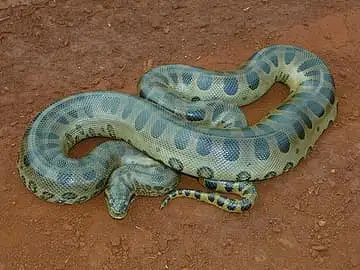
The green anaconda is the world's heaviest snake, sometimes over 100 kg and well over 5 m long. It waits in shallow water with only its eyes and nostrils showing, then wraps prey in its coils. It is not venomous.
See it on the 3D globe →At a glance
- Class
- Reptiles
- Lives in
- Orinoco basin, Venezuela
- Diet
- Meat eater (carnivore)
- Weight
- about 55 kg
- Length
- about 4.5 m
- Lifespan
- up to about 10 years
- Conservation status
- Least Concern (IUCN LC)
- Habitat
- wetlands, rivers & lakes, rainforests
Quick answers
Where does the Green anaconda live?
It lives in wetlands, rivers & lakes, rainforests. On the globe you can find it near Orinoco basin, Venezuela.
How big is the Green anaconda?
It grows to about 4.5 m and 55 kg.
What does the Green anaconda eat?
Its diet: meat eater (carnivore).
How long does the Green anaconda live?
It can live up to about 10 years.
Is the Green anaconda endangered?
It is listed as Least Concern (IUCN LC).
The green anaconda is a huge snake of northern South America. It is one of the longest and heaviest snakes alive and is the heaviest of all, according to the card. Like other boas it is a constrictor and is not venomous.
It lives in tropical rainforests, in shallow, slow-moving water such as streams, rivers and flooded grasslands. It spends most of its time in the water but also goes on land in thick vegetation. It waits with only its eyes and nostrils above the water. It is a member of the boa family, Boidae, and one of its common names is sucuri.
Size and strength
Quiz data lists a typical length of about 4.5 m and a maximum weight of about 97.5 kg. The card says that very large ones may pass 100 kg, so sizes vary by source.
It kills prey by wrapping it in its coils, not by venom. Quiz data lists its typical weight at about 55 kg. Because it hides under water, the anaconda can surprise its prey.
Names and life
Other names include common anaconda, water boa, akayima and sucuri. Linnaeus gave it the name Boa murina in 1758, and it was moved to the genus Eunectes in 1830.
Wikipedia says wild life expectancy is about ten years, though some live longer in captivity. Quiz data suggests up to 30 years. According to Wikipedia, the Latin murinus likely means preying on mice, not mouse-grey.
Fun facts
- Anacondas are not venomous; they kill prey by squeezing it in their coils.
- Anacondas are not venomous.
- It spends most of its time in water.
- The first specimens Linnaeus used were only 75 to 90 cm long.
On the globe
The model shows a green anaconda with its heavy coils. Look at the thick body and the dark spots.
Quiz time
Which is heavier: Green anaconda or Leatherback sea turtle?
Show the answer
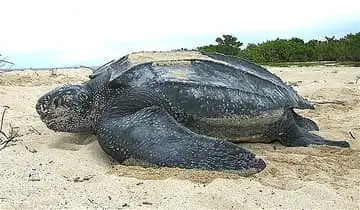
Leatherback sea turtle. (55 kg vs 480 kg) Leatherback sea turtle →
More like this

Sources
Updated: 2026-10-14