
Fire coral
불산호
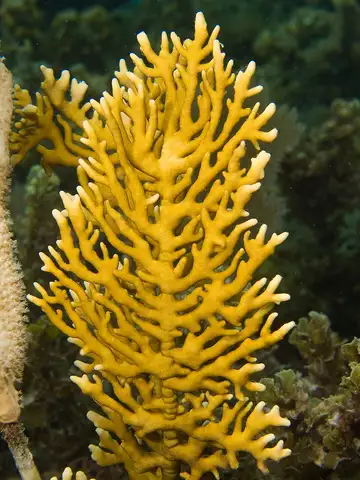
Fire coral is a mustard-yellow colony of the Caribbean and western Atlantic, growing as flat blades or finger-like branches. It is not a true coral but a hydrozoan, and touching it causes a burning sting, hence the name.
See it on the 3D globe →At a glance
- Class
- Jellyfish & corals
- Lives in
- Shallow reefs of the Caribbean and western Atlantic, here off the Yucatán coast
- Habitat
- coral reefs
Quick answers
Where does the Fire coral live?
It lives in coral reefs of the Atlantic Ocean. On the globe you can find it near Shallow reefs of the Caribbean and western Atlantic, here off the Yucatán coast.
Fire corals (genus Millepora) look like stony corals but are not true corals. They are hydrozoans, closer relatives of Hydra and jellyfish-like animals, and are grouped as hydrocorals. The name comes from the flame-like shape of the branches and their yellow, orange and brown colours, and also from the burning feeling when they sting.
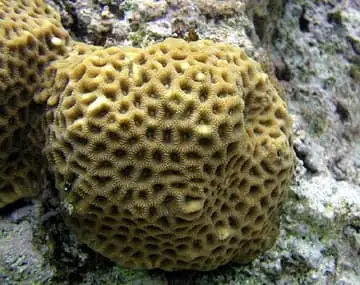
Fire corals live on reefs in tropical and subtropical waters of the Indian, Pacific and Atlantic oceans and the Caribbean, in shallow water with strong currents, down to about 40 metres. They can be yellow or orange, but also brown, green and even blue. A colony grows as branches with rounded finger-like tips, as upright thin plates, or as a crust over other corals. Their skeleton is hard and sharp enough to scrape skin.
How they catch food
Their tiny polyps are embedded in the skeleton and linked by a network of canals. On the smooth surface you can see two kinds of pores. Long, hair-like stinging polyps, called dactylozooids, reach out of the dactylopores to catch prey. Feeding polyps in the gastropores swallow it. Fire coral also gets food from tiny algae called zooxanthellae living in its tissues, which make sugars from sunlight.
A complicated life cycle
Reproduction is more complex than in other reef-building corals. The polyp releases a tiny jellyfish-like stage called a medusa, which sheds its eggs or sperm into the water. A fertilised egg grows into a planula larva, which drifts until it finds a reef to settle on and grows into a polyp again.
Stings and threats
Touching fire coral gives intense pain that can last from two days to two weeks, with redness, itching and sometimes hives. The venom is not deadly to people. After a sting, it is best to see a medical professional, and fresh water makes the pain worse. Fire coral's own enemies include fire worms, certain sea slugs and filefish. Like all reefs, it suffers from pollution, overfishing, damaging fishing methods and coral bleaching caused by climate change.
Fun facts
- It is not a true coral but a relative of jellyfish, and touching it gives a burning sting.
- It is not a true coral but a relative of jellyfish.
- It stings with hair-like polyps.
- It can be yellow, orange, brown, green or even blue.
- Its skeleton can scrape skin.
On the globe
The model shows branching yellow-orange coral, as in the card. Look at the branching fingers.
More like this
.jpg)
Sources
Updated: 2026-10-14