
Giant Caribbean sea anemone
카리브바다말미잘
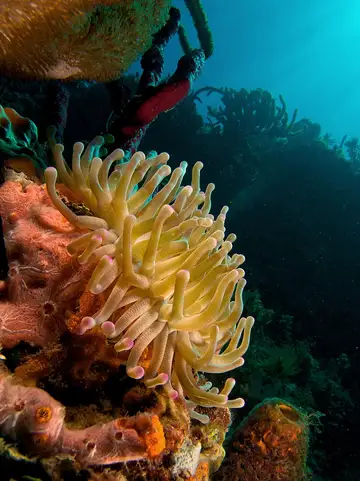
The giant Caribbean sea anemone is a big anemone of Caribbean reefs and rocky crevices. Its long pale green-brown tentacles end in pink or purple tips and can reach about 15 cm. Cleaner shrimps and small fish often live beside it.
See it on the 3D globe →At a glance
- Class
- Jellyfish & corals
- Lives in
- Reefs and rocky crevices of the Caribbean, here off Jamaica
- Diet
- Meat eater (carnivore)
- Habitat
- coral reefs
Quick answers
Where does the Giant Caribbean sea anemone live?
It lives in coral reefs of the Atlantic Ocean. On the globe you can find it near Reefs and rocky crevices of the Caribbean, here off Jamaica.
What does the Giant Caribbean sea anemone eat?
Its diet: meat eater (carnivore).
The giant Caribbean sea anemone is a large, flower-like animal of warm shallow reefs and rocky crevices in the Caribbean Sea, the western Atlantic and the waters from southern Florida through the Florida Keys. It can grow about 15 centimetres tall and its disc can be around 40 centimetres wide.
Its mouth is surrounded by 100 or more long tentacles, often pale green-brown with pink or purple tips. The tentacles carry stinging cells, but small cleaner shrimps and fish move in among them and are protected there. Divers often find these anemones standing alone or in loose groups, never in true colonies.
Where does it live?
The anemone usually sits in crevices of rock walls or fixed to a rock, shell or other hard object in shallow water where the sea is salty and clean. It is common on forereef slopes and in lagoons, and also very common around Bermuda. In these places it acts like a small village centre, because it gives shelter to several kinds of fish and cleaner shrimp, which use it as a base for cleaning fish.
Life cycle and its tiny partners
Giant Caribbean sea anemones mostly have separate males and females. In late May they release eggs and sperm into the water, where fertilization happens. The baby, called a planula larva, drifts, settles on the sea floor and grows a base to become a full anemone. This species is also a favourite of scientists studying how anemones live with tiny algae inside their bodies.
Fun facts
- Small shrimps and fish live among its stinging tentacles for protection.
- Its mouth is surrounded by 100 or more tentacles.
- Small shrimp and fish live among its stinging tentacles for protection.
- It is common around the island of Bermuda.
- Scientists use it as a model animal to study partnerships with algae.
On the globe
The model sits off Jamaica. Zoom in on the reef there and look for the long tentacles with colourful tips.
More like this
.jpg)
Sources
Updated: 2026-10-14