
Upside-down jellyfish
거꾸로해파리
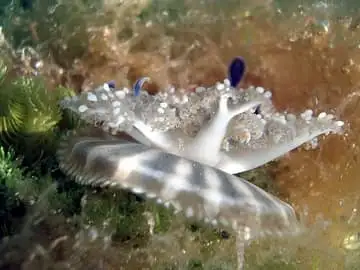
The upside-down jellyfish, Cassiopea, rests on shallow sandy or muddy sea floors with its bell down and its arms up. Algae living inside its tissues make food from sunlight and share it, so it lies in the sun like a living solar panel.
See it on the 3D globe →At a glance
- Class
- Jellyfish & corals
- Habitat
- coasts, coral reefs
Quick answers
Where does the Upside-down jellyfish live?
It lives in coasts, coral reefs of the Atlantic, Pacific and Indian oceans.
The upside-down jellyfish, Cassiopea, is a jellyfish that does something odd: it lies on the sea floor with its bell down and its frilly arms pointing up. It lives in warm, shallow coastal waters such as mangroves, mudflats, lagoons and sea-grass beds in Florida, the Caribbean, Hawaii, the Red Sea and the Mediterranean.
The reason for the odd pose is light. Tiny algae live inside its tissues and make food from sunlight, then share it with the jellyfish, so it needs to lie in a sunny spot. Scientists have even noticed that it seems to sleep, although it has no brain. The group includes about 11 species.
Why does it lie upside down?
Cassiopea has a partnership with microscopic algae called dinoflagellates. They live inside its body and make sugars using sunlight, which feed their host. To give them enough light, the jellyfish rests on shallow bottoms with its arms turned upward like a living solar panel. Unlike most jellyfish it swims only rarely, and it appears to catch prey in unusual ways, and at least one species releases stinging cells into its mucus.
A traveller around the world
Several Cassiopea species have spread beyond their home waters, carried by ships. After the Suez Canal opened, Cassiopea andromeda reached the canal by 1888 and later the Mediterranean, where it now lives in Malta, Cyprus and the Aegean. In the 1940s, Cassiopea reached Pearl Harbor and then other Hawaiian islands. Modern ship coatings and ballast treatment have made new arrivals less likely.
Fun facts
- It lies upside down on the seabed so that the algae living in its tissues get sunlight.
- It spends most of its life lying on its back on the sea floor.
- It appears to sleep even though it has no brain.
- Some species reached new seas by riding in ships' ballast water.
- The genus is made up of about 11 species.
On the globe
No exact model-site details are listed in the card; zoom into shallow coastal water on the globe to find the jellyfish resting with its arms up.
More like this

Sources
Updated: 2026-10-14