
Gaboon viper
가분살무사
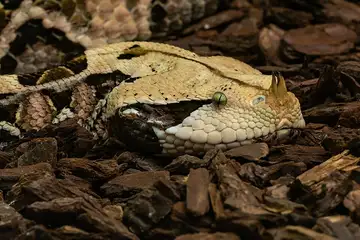
Africa's heaviest viper, its geometric pattern makes it nearly invisible among fallen leaves. Its fangs, up to about 5 cm, are among the longest of any snake. It hunts by ambush.
See it on the 3D globe →At a glance
- Class
- Reptiles
- Lives in
- Leaf litter of Central and West African rainforests
- Diet
- Meat eater (carnivore)
- Length
- about 1.4 m
- Conservation status
- Vulnerable (IUCN VU)
- Habitat
- rainforests
Quick answers
Where does the Gaboon viper live?
It lives in rainforests. On the globe you can find it near Leaf litter of Central and West African rainforests.
How big is the Gaboon viper?
It grows to about 1.4 m.
What does the Gaboon viper eat?
Its diet: meat eater (carnivore).
Is the Gaboon viper endangered?
It is listed as Vulnerable (IUCN VU).
The Gaboon viper is a large, very venomous snake that lives in the rainforests and savannas of sub-Saharan Africa. It is the biggest snake in its genus, Bitis, and the heaviest venomous snake in Africa. Adults are usually 125 to 155 centimetres long, and a heavy female can weigh 8.5 kilograms.
Its head is big and triangular, and its neck is narrow. The patterned back, with pale rectangles and dark hourglass shapes, looks bright in the open. On a forest floor covered with dead leaves, though, it blends in so well that even a keeper can miss a snake that is lying in plain view. The Gaboon viper has the longest fangs of any venomous snake, up to about 5 centimetres.
Where does it live?
The snake is found in many countries from Guinea and Ghana to Uganda, Kenya, Tanzania, Mozambique and northeast KwaZulu-Natal in South Africa. It lives mostly in rainforests and nearby woods at low altitude, though it is sometimes found up to about 1,500 metres. Scientists have argued about whether a western form deserves to be a separate species, Bitis rhinoceros, because the two forms differ as much genetically as they do from another viper.
How does it hunt and defend itself?
The camouflage is the key. The viper lies still among the leaves and strikes whatever passes by. Its body is thick and heavy, and the head is pale or cream with a dark line and a dark triangle behind each eye. A frog called the Congolese giant toad may copy the snake's head to look dangerous. Because the viper has the highest venom yield of any snake and very long fangs, people should keep well away from it, and it is best watched from a distance.
Fun facts
- Its fangs can reach about 5 centimetres, the longest of any venomous snake.
- It has the highest venom yield of any snake.
- A frog, the Congolese giant toad, seems to copy its head shape.
On the globe
The toy model shows the Gaboon viper on the forest floor in Central and West Africa. Look for the geometric leaf-like pattern.
Quiz time
Which is longer: Gaboon viper or Saharan horned viper?
Show the answer
Gaboon viper. (1.4 m vs 0.5 m) Saharan horned viper →
More like this


Sources
Updated: 2026-10-14