
Loggerhead sea turtle
붉은바다거북
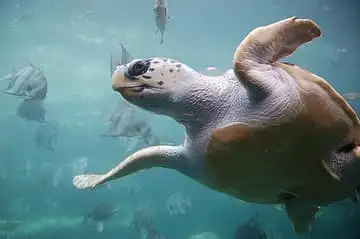
A sea turtle with an unusually large head and powerful jaws that crush crabs and shells. It can weigh over 100 kg, and females return decades later to nest on the beach where they hatched. It migrates across entire oceans.
See it on the 3D globe →At a glance
- Class
- Reptiles
- Diet
- Meat eater (carnivore)
- Weight
- about 135 kg
- Length
- about 0.9 m
- Lifespan
- up to about 67 years
- Conservation status
- Vulnerable (IUCN VU)
- Habitat
- coasts, open ocean
Quick answers
Where does the Loggerhead sea turtle live?
It lives in coasts, open ocean of the Pacific, Atlantic and Indian oceans.
How big is the Loggerhead sea turtle?
It grows to about 0.9 m and 135 kg.
What does the Loggerhead sea turtle eat?
Its diet: meat eater (carnivore).
How long does the Loggerhead sea turtle live?
It can live up to about 67 years.
Is the Loggerhead sea turtle endangered?
It is listed as Vulnerable (IUCN VU).
The loggerhead sea turtle, Caretta caretta, is a marine reptile found in the Atlantic, Pacific and Indian Oceans and the Mediterranean Sea. A grown loggerhead has a carapace, or top shell, about 90 centimetres long and weighs around 135 kilograms, and the biggest reach about 200 kilograms. Its shell is reddish brown and its skin yellow to brown. It is named for its large head and strong jaws, which crush its main food of bottom-dwelling animals.
It spends most of its life in salt water and estuaries, and females come ashore only briefly to lay eggs. A loggerhead takes 17 to 33 years to mature and lives about 47 to 67 years. The IUCN lists it as Vulnerable, and international trade in loggerheads or their products is banned under CITES Appendix I. Nine distinct population segments are protected under the US Endangered Species Act.
A very wide menu
The loggerhead is an omnivore, feeding mostly on bottom-dwelling animals such as whelks, conchs, clams and horseshoe crabs. It has the longest list of known prey of any sea turtle, including sponges, corals, sea anemones, squid, sea urchins, starfish, fish and algae. On open-sea journeys it eats jellyfish, floating molluscs and flying fish.
It crushes food with its big jaws and uses pointed scales on its front flippers as pseudo-claws to tear large pieces. Mucus-covered, inward-pointing papillae in its throat filter out foreign objects such as fish hooks.
Nests, hot sand and the first night
Females lay about four clutches in a season, then rest for two to three years. Mating usually takes place along migration routes rather than near the nesting beach. The eggs are laid above the high-tide line, and the temperature of the sand decides the sex: eggs at 32 degrees Celsius become females, at 28 degrees males, and at 30 degrees about half and half.
After about 80 days the hatchlings, only about 4.6 cm long and 20 g, dig out, usually at night. They find the sea by heading for the brighter horizon, where moon and starlight reflect off the water. They can lose up to 20 percent of their weight on the way.
Dangers and help
Loggerheads were once hunted heavily for meat and eggs, and this still happens where rules are not enforced. Today the greatest threat is the loss of nesting beaches to coastal development, together with nest predators and coastal lights that confuse hatchlings. Abandoned fishing gear and trawl nets also kill many turtles.
Turtle excluder devices give turtles an escape route from nets. Pacific loggerheads cross the whole ocean from nesting beaches in Japan to feed off California and Baja California, where fisheries put them at risk.
Fun facts
- Young loggerheads that hatch in Japan can cross the whole Pacific to feed off Mexico before returning.
- The temperature of the nest decides whether a hatchling is male or female.
- Hatchlings find the sea by following the bright horizon over the water.
- It has a longer list of prey than any other sea turtle.
- Pacific loggerheads swim from nesting beaches in Japan to California.
On the globe
The model shows a loggerhead sea turtle with a big head swimming in the open ocean.
Quiz time
Which is heavier: Loggerhead sea turtle or Nile crocodile?
Show the answer
Nile crocodile. (135 kg vs 300 kg) Nile crocodile →
More like this

Sources
Updated: 2026-10-14