
Green sea turtle
푸른바다거북
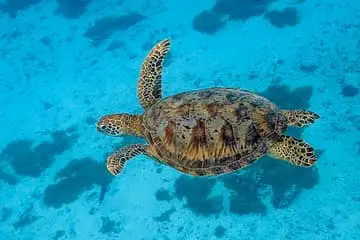
A sea turtle named for its greenish fat, returning to the very beach where it hatched to lay eggs. Those nesting on Ascension swim roughly 2,000 km from Brazil, and adults feed mainly on seagrass and algae.
See it on the 3D globe →At a glance
- Class
- Reptiles
- Lives in
- South Atlantic, near Ascension Island
- Diet
- Plant eater (herbivore)
- Weight
- about 130 kg
- Length
- about 1 m
- Lifespan
- up to about 80 years
- Conservation status
- Least Concern (IUCN LC)
- Habitat
- coasts, coral reefs, open ocean
Quick answers
Where does the Green sea turtle live?
It lives in coasts, coral reefs, open ocean of the Pacific, Atlantic and Indian oceans. On the globe you can find it near South Atlantic, near Ascension Island.
How big is the Green sea turtle?
It grows to about 1 m and 130 kg.
What does the Green sea turtle eat?
Its diet: plant eater (herbivore).
How long does the Green sea turtle live?
It can live up to about 80 years.
Is the Green sea turtle endangered?
It is listed as Least Concern (IUCN LC).
The green sea turtle is a large sea turtle with a teardrop-shaped shell and two big paddle-like flippers. Its shell is olive to black, so the name does not come from the shell. It comes from the greenish fat under it, which comes from the sea grass it eats.
It lives in warm seas all over the world. Adults are the only sea turtles that mostly eat plants, grazing on seagrass and algae in shallow lagoons. Some of them can live up to 90 years in the wild. Many beaches carry the name Turtle Island, because green turtles come back to nest there year after year.
Long trips home
Green turtles swim long distances between feeding grounds and nesting beaches. Females crawl onto a beach at night, dig a nest and lay their eggs. The hatchlings scramble to the sea after they come out.
Those that nest on Ascension Island in the South Atlantic swim roughly 2,000 kilometres from Brazil, and females often come back to the beach where they hatched. The turtles have to cross the sea to get there, and a hatchling has a very small chance of reaching adulthood.
Keeping them safe
Green turtles were listed as endangered by the IUCN until 2025, and they are protected in most countries. It is illegal to hunt them or collect their eggs in many places.
They still face dangers: fishing nets, plastic pollution, hunting in some countries, and the loss of nesting beaches to buildings. Many islands are called Turtle Island because turtles nest there.
Fun facts
- It is named not for its shell but for the greenish colour of its fat.
- It is named for its green fat, not its shell.
- It is the only sea turtle that eats mainly plants as an adult.
- Many islands around the world are called Turtle Island because turtles nest on their beaches.
On the globe
The globe places the green sea turtle near Ascension Island in the South Atlantic. Look for its paddle-shaped flippers.
Quiz time
Which is heavier: Green sea turtle or Leatherback sea turtle?
Show the answer
Leatherback sea turtle. (130 kg vs 480 kg) Leatherback sea turtle →
More like this
_Moorea.jpg)
Sources
Updated: 2026-10-14