
Saharan horned viper
사하라뿔독사
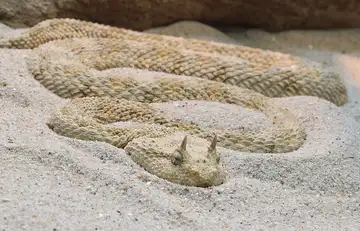
The Saharan horned viper is a small venomous snake, usually 50 to 60 cm long, with a pointed scale like a horn above each eye. It buries itself in sand to ambush prey and travels by sidewinding.
See it on the 3D globe →At a glance
- Class
- Reptiles
- Lives in
- Sahara and Arabian deserts
- Diet
- Meat eater (carnivore)
- Length
- about 0.5 m
- Conservation status
- Least Concern (IUCN LC)
- Habitat
- deserts
Quick answers
Where does the Saharan horned viper live?
It lives in deserts. On the globe you can find it near Sahara and Arabian deserts.
How big is the Saharan horned viper?
It grows to about 0.5 m.
What does the Saharan horned viper eat?
Its diet: meat eater (carnivore).
Is the Saharan horned viper endangered?
It is listed as Least Concern (IUCN LC).
The Saharan horned viper is a small venomous snake of the deserts of North Africa and parts of the Arabian Peninsula and the Levant. Its most striking feature is a pair of horn-like scales, one above each eye, although some snakes have no horns at all. Adults are usually 30 to 60 centimetres long, and the biggest recorded was 85 centimetres.
The snake lives in dry, sandy areas with a few rocky outcrops, sometimes near oases and as high as 1,500 metres. Its colour, yellowish, pale grey, pinkish or reddish brown, almost always matches the sand it lives on, and dark blotches run along the back. The IUCN lists it as Least Concern. The globe places it in the Sahara and Arabian deserts.
Sidewinding on sand
Hot desert sand is hard to cross, so this viper moves by sidewinding: it throws its body sideways in loops and presses it into the sand, leaving a trail of whole-body prints. It is mostly active at night and buries itself in sand with only its eyes and horns showing, waiting to ambush prey. It has a fairly calm temperament, but if threatened it may rub its coils together to make a warning sound.
Names old and new
Females are larger than males, while males have larger heads and eyes. Besides its common names such as desert horned viper, it is called el-ṭorîsha in Egypt and um-Goron in Libya. In ancient Egyptian writing, the picture of a horned viper stood for the sound f. Scientists have described three subspecies. The horns may be small or missing, and horns are more often found in this species than in its close relative.
Fun facts
- It buries itself in sand with only its eyes and 'horns' showing, and moves by sidewinding.
- It buries itself in sand with only its eyes and horns showing.
- In ancient Egyptian hieroglyphs a horned viper stands for the letter f.
- Some of these vipers have no horns at all.
On the globe
The globe places the viper in the Sahara and Arabian deserts. Look for the sand-coloured body and the pair of horns above its eyes.
Quiz time
Which is longer: Saharan horned viper or Loggerhead sea turtle?
Show the answer
Loggerhead sea turtle. (0.5 m vs 0.9 m) Loggerhead sea turtle →
More like this

Sources
Updated: 2026-10-14