
Yeti crab
예티크랩
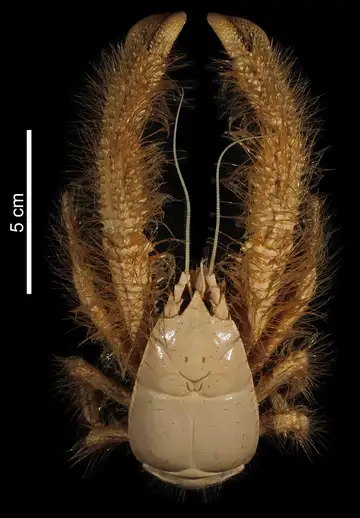
Found in 2005 at a vent about 2,200 m deep south of Easter Island, it has claws covered in hair-like setae. It is thought to farm sulphur-eating bacteria on them and eat them.
See it on the 3D globe →At a glance
- Class
- Crustaceans
- Lives in
- Hydrothermal vents, Pacific-Antarctic Ridge
- Length
- about 0.15 m
- Habitat
- deep sea
Quick answers
Where does the Yeti crab live?
It lives in deep sea of the Pacific Ocean. On the globe you can find it near Hydrothermal vents, Pacific-Antarctic Ridge.
How big is the Yeti crab?
It grows to about 0.15 m.
The yeti crab, Kiwa hirsuta, is a deep-sea crustacean about 15 centimetres long. Its claws and legs are covered with silky, blond, fur-like bristles called setae, which is why it was nicknamed the yeti crab or yeti lobster.
It was discovered in March 2005 by a team using the submersible Alvin, and the discovery was announced in March 2006. It lives on hydrothermal vents on the Pacific-Antarctic Ridge, about 1,500 kilometres south of Easter Island and 2,200 metres deep. Few people have ever seen it alive; scientists find it using submersibles. Its home is a hot, dark, mineral-rich place on the seafloor where few animals can survive.
Farming bacteria
The crab's eyes are tiny and have no pigment, and it is probably blind. Its hairy claws hold chemosynthetic bacteria, which may help it detoxify minerals in the vent water. Scientists believe the bacteria are also its food.
Its sister species, Kiwa puravida, uses specially modified hairs near its mouth to harvest the bacteria. The crab's pale body and hair make it one of the most unusual deep-sea animals known.
A whole new family
Because it was so different in both body shape and DNA, scientists placed it in its own new family, Kiwaidae.
A second species, Kiwa puravida, was found in 2006 and formally described in 2011. The vents give hot water that creates a warm home in the cold dark deep. The group of researchers who found it was led by scientists from the Monterey Bay Aquarium Research Institute and Ifremer.
Fun facts
- Its claws are covered in blond hair-like bristles.
- It was found in 2005 near Easter Island.
- It is placed in a brand-new family, Kiwaidae.
On the globe
The model shows a pale crab with hairy claws on a deep-sea vent.
More like this
_002.jpeg)
Sources
Updated: 2026-10-14