
Giant trevally
자이언트트레발리
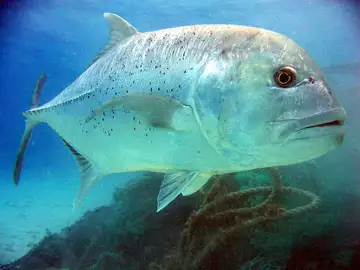
The giant trevally is a big, deep-bodied silver jack with a blunt head that hunts smaller fish along reef edges. It can grow beyond 1.7 m and 80 kg, and has even been filmed snatching seabirds from the surface.
See it on the 3D globe →At a glance
- Class
- Fish
- Lives in
- Waters off Mauritius and Réunion
- Diet
- Fish eater
- Conservation status
- Least Concern (IUCN LC)
- Habitat
- coral reefs, coasts
Quick answers
Where does the Giant trevally live?
It lives in coral reefs, coasts of the Indian and Pacific oceans. On the globe you can find it near Waters off Mauritius and Réunion.
What does the Giant trevally eat?
Its diet: fish eater.
Is the Giant trevally endangered?
It is listed as Least Concern (IUCN LC).
The giant trevally is a large marine fish of the jack family. It lives in tropical waters of the Indo-Pacific, from South Africa to Hawaii, including Japan in the north and Australia in the south. Young fish live in estuaries, shallow bays and even the low-salt upper reaches of rivers, while adults prefer deeper reefs, offshore atolls and large bays.
It is the largest fish in its genus, Caranx, growing to 170 centimetres and 80 kilograms. It is usually silvery with a few dark spots, but mature males may turn black. The head profile is steep and the tail has strong scutes, which are tough plates near the tail. It is an apex predator, meaning it sits at the top of the food chain in most places where it lives.
What does it eat, and how does it hunt?
Mostly fish, but in some regions crustaceans, cephalopods and molluscs make up a big part of its diet. It hunts alone or in schools. Scientists have recorded clever tricks: shadowing monk seals to catch prey that the seals scare, using sharks to ambush prey, and leaping from the water to catch birds, such as young seabirds in flight. Its main prey are fish, although it also takes crabs and shrimp-like animals.
Growing up
Spawning happens in the warmer months, with large schools gathering over reefs and bays at certain stages of the lunar cycle. The fish grows quickly and is mature at about 60 centimetres and three years old. People catch it for food and for sport, but ciguatera poisoning is common from eating the fish. Numbers have dropped around the main Hawaiian Islands, and several proposals have been made to reduce the catch there.
Fun facts
- Giant trevallies have been filmed leaping out of the water to catch young seabirds in flight.
- It can grow up to 170 centimetres and 80 kilograms.
- It has been seen leaping out of the water to catch birds.
- It sometimes follows monk seals to catch the prey they scare away.
On the globe
The toy model of the giant trevally patrols the waters off Mauritius and Réunion. Look for the blunt, steep head.
More like this

Sources
Updated: 2026-10-14