
Sand tiger shark
샌드타이거상어
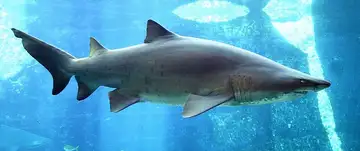
The sand tiger shark looks fierce thanks to its jagged teeth sticking out of its mouth, yet it is fairly docile. About 3 m long, it can gulp air at the surface and hold it in its stomach to hover in the water as a buoyancy aid.
See it on the 3D globe →At a glance
- Class
- Fish
- Lives in
- Off Durban, South Africa
- Diet
- Fish eater
- Weight
- about 120 kg
- Length
- about 2.7 m
- Conservation status
- Critically Endangered (IUCN CR)
- Habitat
- coasts, coral reefs
Quick answers
Where does the Sand tiger shark live?
It lives in coasts, coral reefs of the Atlantic, Pacific and Indian oceans. On the globe you can find it near Off Durban, South Africa.
How big is the Sand tiger shark?
It grows to about 2.7 m and 120 kg.
What does the Sand tiger shark eat?
Its diet: fish eater.
Is the Sand tiger shark endangered?
It is listed as Critically Endangered (IUCN CR).
The sand tiger shark looks scary, with jagged teeth poking out of its mouth, but it is actually slow-moving and relatively placid. It lives in subtropical and temperate waters around the world, from sandy shores and underwater reefs down to roughly 190 metres deep. It goes by other names too, such as the grey nurse shark in Australia and the spotted ragged-tooth shark in South Africa.
It is usually 2.2 to 2.5 metres long and can reach about 3.2 metres. The body is grey with reddish-brown spots on the back. There are no confirmed human deaths from this shark. The IUCN lists it as critically endangered, even though it is the large shark most often kept in public aquariums.
How does it float and hunt?
Unlike other sharks, the sand tiger can gulp air at the surface, which lets it hang in the water with very little effort, like a diver using a buoyancy vest. Groups called shivers have been seen hunting big schools of fish. The diet includes bony fish, crustaceans, squid, skates and other sharks.
A surprising way to be born
During pregnancy, the most developed embryo eats its brothers and sisters inside the mother. Scientists call this adelphophagy, which literally means eating one's brother. It is one of the unusual ways sharks can reproduce. Despite its name, the sand tiger is not closely related to the tiger shark or the nurse shark. Its name comes from the sandy shores where it often swims.
Fun facts
- It gulps air at the surface and holds it in its stomach so it can hover motionless in the water.
- It can swallow air at the surface and hold it in its stomach to hover.
- The strongest unborn pup eats its siblings before birth.
- It was last seen in the Mediterranean in 2003 and is presumed gone from there.
- It tolerates captivity well, so it is common in aquariums.
On the globe
The toy model shows a sand tiger shark off Durban, South Africa, where it is called the ragged-tooth shark.
Quiz time
Which is heavier: Sand tiger shark or Great white shark?
Show the answer
Great white shark. (120 kg vs 770 kg) Great white shark →
More like this

Sources
Updated: 2026-10-14