
Argali
아르갈리
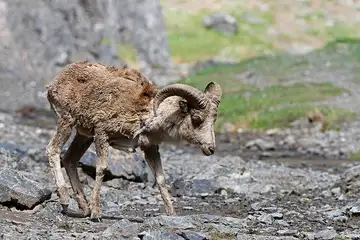
The argali is the largest wild sheep in the world. Rams can weigh over 100 kg and carry massive spiralling horns more than a metre long. They live in herds on the rocky slopes and plateaus of Central Asia.
See it on the 3D globe →At a glance
- Class
- Mammals
- Lives in
- Central Asian highlands and the Altai
- Diet
- Plant eater (herbivore)
- Conservation status
- Near Threatened (IUCN NT)
- Habitat
- mountains, grasslands
Quick answers
Where does the Argali live?
It lives in mountains, grasslands. On the globe you can find it near Central Asian highlands and the Altai.
What does the Argali eat?
Its diet: plant eater (herbivore).
Is the Argali endangered?
It is listed as Near Threatened (IUCN NT).
The argali is the largest wild sheep in the world. It lives in the highlands of Central Asia, including the Altai Mountains, Tibet and the Himalayas. The name 'argali' is the Mongolian word for wild sheep. It stands 85 to 135 cm tall at the shoulder and is 136 to 200 cm long.
Males, called rams, usually weigh between 97 and 328 kg, and the biggest recorded was 356 kg. They carry huge corkscrew horns, some measuring 190 cm along their length and weighing up to 23 kg. Ewes are much smaller, sometimes weighing less than half as much as the rams, and their horns stay under 60 cm.
Horns for competing
Rams use their horns to compete with one another. The horns spiral round in a big corkscrew shape. During the rut, which can run from October to mid-January, both rams and ewes ram each other to show who is boss. A fight between two grown males is serious: they slam together with their front legs in the air, and the crash can be heard 800 metres away. Older males over six years, which are often the largest, usually win the right to approach the ewes.
Colours and subspecies
The coat varies from light yellow through reddish-brown to dark grey-brown. Argali from the Himalayas are usually darker, while those from Russian ranges are often paler. The face, tail and rump are yellowish-white, and the argali has the shortest tail of any wild sheep or goat-antelope, only about 9.5 to 17 cm. Males also grow a pale neck ruff.
Nine subspecies are recognised today, such as the Altai, Gobi and Tibetan argali. The largest is the Pamir argali, or Marco Polo sheep, named after the traveller who first described it.
Mountain herds
Argali live from about 300 up to 5,800 metres above sea level, from central Kazakhstan to China's Shanxi province and from the Altai down to the Himalayas. They gather in herds of two to 150 animals, with rams and ewes mostly apart. Mothers and lambs form larger groups, sometimes of dozens. They look for places where winds blow the snow off the ground, and some herds migrate when food is short. A pregnancy lasts a little over 165 days, and most ewes give birth to a single lamb in March or April.
Fun facts
- A male's huge curled horns can weigh more than 20 kg.
- It is the largest wild sheep.
- A ram's horns can weigh up to 23 kg.
- The Pamir argali is also called the Marco Polo sheep.
- Its tail is only about 9.5 to 17 cm long, the shortest of any wild sheep.
On the globe
The model shows a big wild sheep with massive spiralling horns, as in the card. Look at the curl of the horns.
More like this

Sources
Updated: 2026-10-14