
Marine iguana
바다이구아나
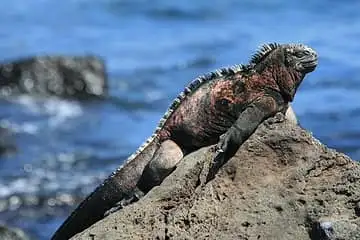
Found only in the Galápagos, the only lizard in the world that feeds in the sea. It warms up on black rocks, dives to graze on algae, and sneezes out the extra salt through glands near its nose.
See it on the 3D globe →At a glance
- Class
- Reptiles
- Diet
- Plant eater (herbivore)
- Lifespan
- up to about 60 years
- Conservation status
- Vulnerable (IUCN VU)
- Habitat
- coasts
Quick answers
Where does the Marine iguana live?
It lives in coasts of the Pacific Ocean.
What does the Marine iguana eat?
Its diet: plant eater (herbivore).
How long does the Marine iguana live?
It can live up to about 60 years.
Is the Marine iguana endangered?
It is listed as Vulnerable (IUCN VU).
The marine iguana (Amblyrhynchus cristatus) lives only on the Galapagos Islands of Ecuador. It is the only living lizard that spends time in the sea, where it feeds on algae, which make up almost all of its diet. It also has a low crest of spines along its back, which gives it the species name cristatus, meaning crested.
Large males dive for food, while females and smaller males feed in the intertidal zone at low tide. Colonies live mainly on rocky shores, where the animals bask on black rocks after visiting the cold water, but they can also be seen in marshes, mangrove swamps and beaches. The species is protected but considered threatened, mostly because of El Nino cycles, introduced predators and accidents such as oil spills.
Living by the sea
Large males defend territories for a short time, while smaller males use other breeding tricks. After mating, a female digs a nest hole in the soil, lays her eggs and leaves them to hatch on their own a few months later.
The British naval captain James Colnett wrote in 1798 that the iguanas were of a sooty black that heightened their native ugliness, and early visitors found them disgusting. Thomas Bell gave the species its scientific name in 1825, though he wrongly believed the specimen came from Mexico.
Where did they come from?
Researchers think the Galapagos land iguanas and marine iguanas share a common ancestor that arrived from Central or South America, probably by rafting. One genetic study estimated that the two split 5 to 15 million years ago, but a later study using more DNA suggested about 4.5 million years ago, near the age of the oldest existing islands.
The two kinds can still have young together. Where their ranges overlap, rare hybrid iguanas have been recorded on tiny South Plaza island. These hybrids stay on land and cannot have young themselves.
A different look on every island
Marine iguanas vary in appearance between islands, and for many years seven or eight subspecies were recognised. A 2017 review used body shape and genes and recognised eleven, including one on San Cristobal named godzilla, after the movie monster.
Even the oldest split between island populations is recent, no more than about 230,000 years and probably under 50,000. Sometimes one reaches another island, and in 2014 one appeared on Isla de la Plata, near the mainland, the only confirmed record outside the Galapagos.
Fun facts
- It is the only lizard in the world that feeds in the sea.
- Thomas Bell first described it in 1825.
- One subspecies from San Cristobal is named godzilla.
- Marine iguanas look different from island to island.
On the globe
The model shows a marine iguana basking on black rocks beside the sea on the Galapagos Islands.
More like this
.jpg)
Sources
Updated: 2026-10-14