
Norway lemming
노르웨이레밍
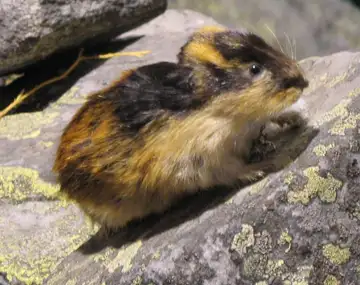
The Norway lemming is a small, boldly patterned rodent of Scandinavia's mountain tundra. Its numbers boom and crash every few years, and it migrates when crowded; the myth of mass suicide is false.
See it on the 3D globe →At a glance
- Class
- Mammals
- Lives in
- Mountain tundra of Scandinavia
- Diet
- Plant eater (herbivore)
- Conservation status
- Least Concern (IUCN LC)
- Habitat
- polar regions, mountains
Quick answers
Where does the Norway lemming live?
It lives in polar regions, mountains. On the globe you can find it near Mountain tundra of Scandinavia.
What does the Norway lemming eat?
Its diet: plant eater (herbivore).
Is the Norway lemming endangered?
It is listed as Least Concern (IUCN LC).
The Norway lemming (Lemmus lemmus) is a small rodent of the tundra and fells of northern Fennoscandia, and it is the only vertebrate animal found only in that region. It lives from western Norway east to the Kola Peninsula and prefers places near water. Adults feed mostly on sedges, grasses and moss, and they are active both day and night, alternating naps with periods of activity.
It is easy to spot because of its bold black and yellow-brown pattern, which varies from animal to animal. It grows to about 15.5 centimetres, has a very short tail of 1 to 2 centimetres and weighs up to 130 grams. A 2021 study suggests that grey lemmings on Novaya Zemlya, far to the east, may belong to the same species, though this has not been fully accepted.
Booms and crashes
The Norway lemming has a dramatic three- to four-year population cycle. Numbers rise to unsustainable levels, many then die, and the population crashes again. In good years, with short winters and long summers, they can breed year-round and become mature less than a month after birth, producing six to eight young every three to four weeks.
Lemmings are solitary by nature, so stronger ones drive weaker and younger ones away long before food runs short. The young scatter in all directions looking for empty territory.
The cliff-jumping myth
Lemmings do migrate, sometimes in vast numbers, but the idea of a deliberate march into the sea is false. Where the land funnels them into a narrow corridor, crowds can build up, causing stress and finally panic, so that they flee in every direction.
Despite their small size, lemmings turn highly aggressive when a predator comes close, and they have even attacked people. Researchers suggest that their bold colours, loud calls and aggression warn small predators that they can bite back.
Life through the seasons
The Norway lemming spends the winter in nests under the snow. When the spring thaw starts and snow begins to collapse, it must move to higher ground where the snow is still firm, or more often to lower ground for the summer. In autumn it must time the move back carefully, after alpine snow arrives and before the lowlands freeze.
Genetic research suggests it survived the Ice Age in western Europe, in places not covered by ice. In 2021 the lemmings of Novaya Zemlya were described as a subspecies named after the Russian zoologist Yury Chernov.
Fun facts
- The idea that lemmings jump off cliffs together is a myth, spread by a staged scene in a 1958 Disney film.
- Its tail is only about 1 to 2 centimetres long.
- In winter it nests under the snow.
- A group on Novaya Zemlya may belong to the same species, but not everyone agrees.
- Lemmings can reach breeding age less than a month after birth.
On the globe
The model shows a Norway lemming with its boldly patterned fur.
More like this

Sources
Updated: 2026-10-14