
Reindeer
순록
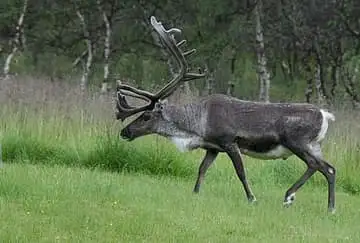
The only deer in which both males and females grow antlers, migrating thousands of km across the Arctic. Its wide hooves spread out like snowshoes, and its thick winter coat of hollow hairs holds in warmth.
See it on the 3D globe →At a glance
- Class
- Mammals
- Lives in
- Lapland, Finland
- Diet
- Plant eater (herbivore)
- Weight
- about 130 kg
- Length
- about 1.9 m
- Top speed
- about 60 km/h
- Lifespan
- up to about 20 years
- Conservation status
- Vulnerable (IUCN VU)
- Habitat
- polar regions, forests, mountains
Quick answers
Where does the Reindeer live?
It lives in polar regions, forests, mountains. On the globe you can find it near Lapland, Finland.
How big is the Reindeer?
It grows to about 1.9 m and 130 kg.
What does the Reindeer eat?
Its diet: plant eater (herbivore).
How fast is the Reindeer?
It can reach about 60 km/h.
How long does the Reindeer live?
It can live up to about 20 years.
Is the Reindeer endangered?
It is listed as Vulnerable (IUCN VU).
The reindeer is a deer of the cold far north, found in northern Europe, Asia and North America, where wild ones are usually called caribou. It lives on the treeless Arctic tundra in summer and in snowy northern forests in winter. It is the only kind of deer in which females, as well as males, can grow antlers.
Reindeer live in herds, and some are enormous: the biggest wild herd, in Russia's Taimyr region, has numbered between 400,000 and 1,000,000 animals. Some herds travel up to 5,000 kilometres in a single year. People have herded reindeer for a very long time, and they are the only deer kept on a large scale like farm animals; in Sweden alone, Sámi herders look after about 250,000 of them.
Amazing body
Reindeer are built for the cold. Their coat has a thick, woolly layer underneath and long hollow hairs on top, filled with air, which hold in warmth and even help them float when they swim. A wide nose warms the freezing air before it reaches the lungs. Their hooves change with the seasons: soft and spongy in summer for grip on boggy ground, then firm with a hard edge in winter to bite into ice and crusty snow. Even their eyes change colour, from gold in summer to blue in winter, which may help them see during the long Arctic darkness.
What it eats
Reindeer are plant-eaters. In summer they eat grasses and other tundra plants, and in winter they rely mostly on lichens, including one known as reindeer lichen. To reach food under the snow, they dig holes called craters with their hooves and broad antlers. Reindeer can also see ultraviolet light, which human eyes cannot. Scientists think this helps them find lichen, which looks dark against bright snow in ultraviolet light.
Family life and is it endangered?
Calves are born in May or June and weigh about 6 kilograms. A calf only one day old can already run faster than an Olympic sprinter, and it keeps drinking its mother's milk until autumn. Reindeer are still common in many places, but the IUCN lists them as Vulnerable because their numbers fell by about 40 percent over 25 years. In Canada, the George River herd shrank from about 800,000 animals in the 1990s to fewer than 9,000 by 2018.
Fun facts
- It is the only deer species in which both males and females grow antlers.
- Many reindeer make a clicking sound as they walk, caused by tendons sliding over small bones in their feet, and it can be heard hundreds of metres away.
- Their eyes turn from gold in summer to blue in winter.
- Reindeer can see ultraviolet light, which is invisible to people.
- A one-day-old reindeer calf can outrun an Olympic sprinter.
- Their hollow hairs act a bit like a life jacket when they swim.
On the globe
The model shows reindeer with tall, branching antlers in Lapland, in northern Finland. Zoom in to look at their big antlers.
Quiz time
Which is heavier: Reindeer or Wolverine?
Show the answer
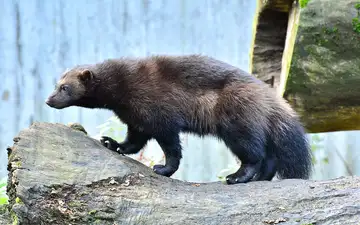
Reindeer. (130 kg vs 12 kg) Wolverine →
More like this


Sources
Updated: 2026-10-13